

Most companies that tried an off-the-shelf AI chatbot in the last two years hit the same wall: it could answer questions, but it couldn’t actually do anything. It couldn’t check inventory, update a CRM record, trigger an approval, or hand off a task to another system without a human stepping in to finish the job. That gap — between “AI that talks” and “AI that acts inside your actual business processes” — is exactly what custom AI agent development is built to close.
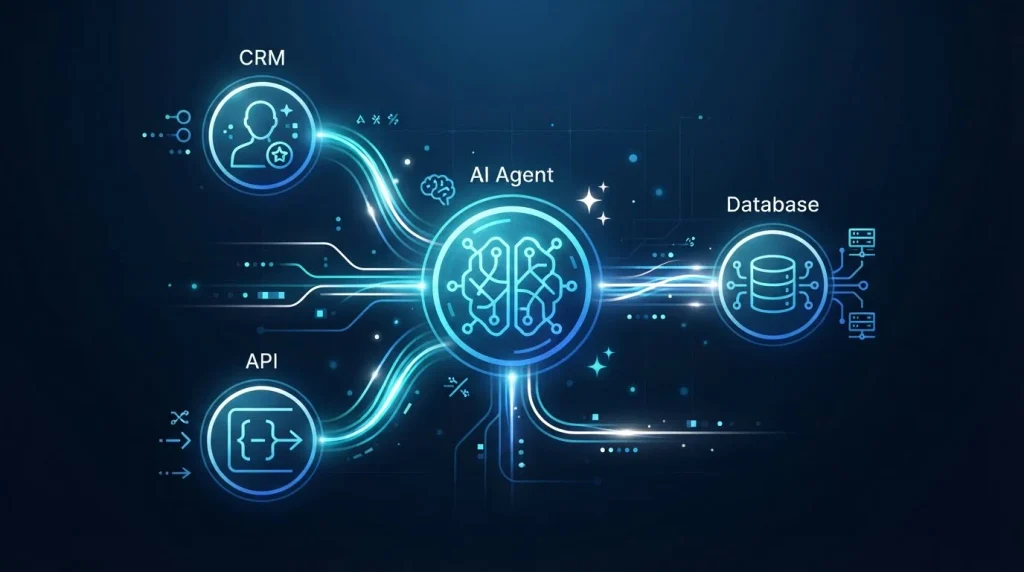
Custom AI agent development is the process of designing, building, and deploying AI systems tailored to a specific company’s workflows, data, and tools, rather than deploying a generic assistant and hoping it fits. Instead of a one-size-fits-all chatbot, a custom agent is built around a defined job — processing purchase orders, triaging support tickets, reconciling invoices — with direct, governed access to the systems it needs to actually complete that job: your CRM, ERP, internal APIs, and data platforms.
The distinction matters more in 2026 than it did even a year ago. Enterprises that experimented with single, standalone AI agents are now running into the same limitation: one agent working in isolation can’t handle the coordination that real business processes require. A support ticket that needs account history pulled, a refund processed, and a CRM note logged isn’t one task — it’s several, often touching several systems, and that’s where purpose-built, custom-developed agent architecture outperforms generic tools. Most organizations that get meaningful ROI from AI agents this year share a common trait: they stopped treating agents as standalone add-ons and started building them as coordinated infrastructure, with real integration and governance behind them.
This guide breaks down what custom AI agent development actually involves — the core architecture, how it compares to no-code and off-the-shelf platforms, realistic cost ranges by project type, and what the build process looks like — so you can evaluate whether it’s the right investment for your business and what to expect if it is.
What Is Custom AI Agent Development?
Direct answer: Custom AI agent development is the process of building an AI system — combining a large language model, retrieval of your company’s data, and direct access to your business tools — designed specifically for one or more defined workflows in your organization, rather than deploying a generic, pre-built assistant.
Unlike a chatbot that only answers questions, a properly built agent can take action: retrieving data, calling internal APIs, updating records, and escalating to a human only when a defined boundary is hit. The “custom” part refers to the fact that the reasoning logic, tool access, and guardrails are all designed around your specific systems and rules, not a generic template.
How Custom AI Agent Development Works: Core Architecture
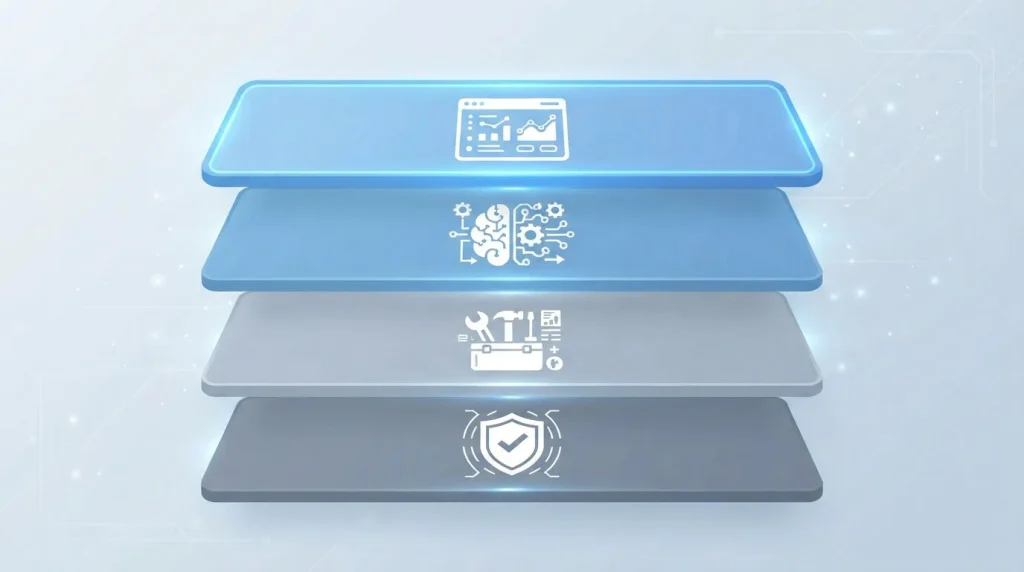
Most agent failures in production trace back to architecture gaps, not the underlying model. A solid custom build typically includes four layers:
- Interface layer — where requests originate (a web app, Slack, email, an internal tool), with user identity and permissions attached at entry.
- Reasoning and orchestration layer — the LLM-driven logic that decides what steps to take, often coordinating multiple specialized sub-agents rather than one agent trying to do everything.
- Tool and integration layer — the actual connections to your CRM, ERP, databases, and internal APIs that let the agent take real action, not just generate text.
- Guardrails and observability — permission boundaries, human-approval checkpoints for high-stakes actions, and logging so every action the agent takes can be reviewed.
Multi-agent orchestration — several narrow, specialized agents coordinating on a task rather than one general-purpose agent — has become the standard pattern for enterprise custom AI agent development in 2026, largely because single agents struggle to meet reliability requirements once a workflow spans multiple systems.

Custom AI Agent Development vs. Off-the-Shelf Platforms
| Header Label | Off-the-Shelf / No-Code | Custom AI Agent Development |
|---|---|---|
| Setup speed | Fast (days) | Slower (weeks to months) |
| Fit to your workflows | Generic, limited customization | Built around your exact process |
| System integrations | Limited to pre-built connectors | Deep, purpose-built integrations |
| Ownership of logic/data | Vendor-controlled | You own the architecture and prompts |
| Best for | Simple, standardized tasks | Complex, multi-system workflows |
No-code platforms make sense for narrow, standardized tasks. Custom development earns its cost when the workflow touches multiple internal systems, requires domain-specific logic, or needs governance that a generic platform can’t provide.
Enterprise Use Cases for Custom AI Agents
The workflows seeing the most traction in 2026 share a common pattern: multiple steps, multiple systems, clear success criteria.
- Customer support — agents that pull account history, resolve tier-1 and tier-2 issues, and escalate complex cases with full context already assembled
- Sales operations — lead enrichment, follow-up sequencing, and CRM updates triggered automatically by deal-stage changes
- Finance and ERP — purchase order creation, invoice extraction, and compliance checks running with minimal manual input
- Internal operations — HR process automation, cross-system reporting, and approval routing
Coordinated systems like these — where several agents work together rather than one agent handling everything — are covered in more depth in our complete guide to autonomous AI workforces.
What Custom AI Agent Development Costs
Pricing varies widely by scope, but typical engagement ranges look roughly like this:
| Engagement Type | Typical Cost | Timeline |
|---|---|---|
| Discovery / feasibility assessment | $5K–$15K | 1–2 weeks |
| Single agent, simple scope | $15K–$50K | 3–6 weeks |
| Single agent, complex/enterprise scope | $50K–$150K | 8–16 weeks |
| Multi-agent system | $100K–$500K | 12–24 weeks |
| Ongoing monitoring and optimization | $2K–$10K/month | Ongoing |
Actual cost depends heavily on how many systems the agent needs to integrate with, how much custom logic and testing the use case requires, and how strict the governance and compliance requirements are.

The Custom AI Agent Development Process
- Discovery — mapping the target workflow, identifying integration points, and estimating realistic ROI before committing to a build.
- Architecture design — deciding on single-agent vs. multi-agent structure, choosing the orchestration approach, and defining guardrails.
- Build and integration — connecting the agent to real systems (CRM, ERP, internal APIs) rather than a demo environment.
- Testing and evaluation — running the agent against real scenarios to catch failure modes before production.
- Deployment and monitoring — launching with logging and drift detection in place, since agent behavior can shift as underlying models or data change.
Choosing a Custom AI Agent Development Partner
The teams that deliver reliable results combine AI architecture expertise with real enterprise integration experience — not just model access. Ask any prospective partner about their approach to orchestration, tool-calling reliability, and failure handling, since these are usually what separate a working production system from a stalled pilot. Reviewing how established firms describe their own AI agent development approach and custom agent build process is a useful way to benchmark what a serious engagement should include. For a closer look at what a full-service engagement typically covers, see our breakdown of enterprise AI agent development services.
Conclusion
Custom AI agent development exists because generic AI tools hit a ceiling the moment a workflow needs to touch multiple systems, follow specific business rules, or meet governance requirements a template can’t anticipate. It costs more and takes longer than an off-the-shelf platform, but for complex, multi-step processes, that investment is what turns “AI that talks” into AI that actually does the work.
FAQ
What does custom AI agent development actually mean?
It’s the process of building an AI agent designed around your specific business workflows and systems — with direct, governed access to tools like your CRM or ERP — rather than deploying a generic pre-built assistant.
How much does custom AI agent development cost?
Costs typically range from $15K–$50K for a simple single agent up to $100K–$500K for a coordinated multi-agent system, depending on integration complexity and governance requirements.
How long does custom AI agent development take?
A simple single-agent build usually takes 3–6 weeks. Complex enterprise systems with multiple integrations or multi-agent coordination can take 12–24 weeks or more.
Do I need custom development, or will an off-the-shelf AI agent work?
Off-the-shelf platforms work well for simple, standardized tasks. Custom development is worth the investment when a workflow spans multiple internal systems, needs domain-specific logic, or has strict governance requirements.
What’s the difference between a single agent and a multi-agent system?
A single agent handles one defined task end to end. A multi-agent system uses several specialized agents that coordinate on a broader workflow — the pattern most enterprises now use for complex, multi-system processes.