
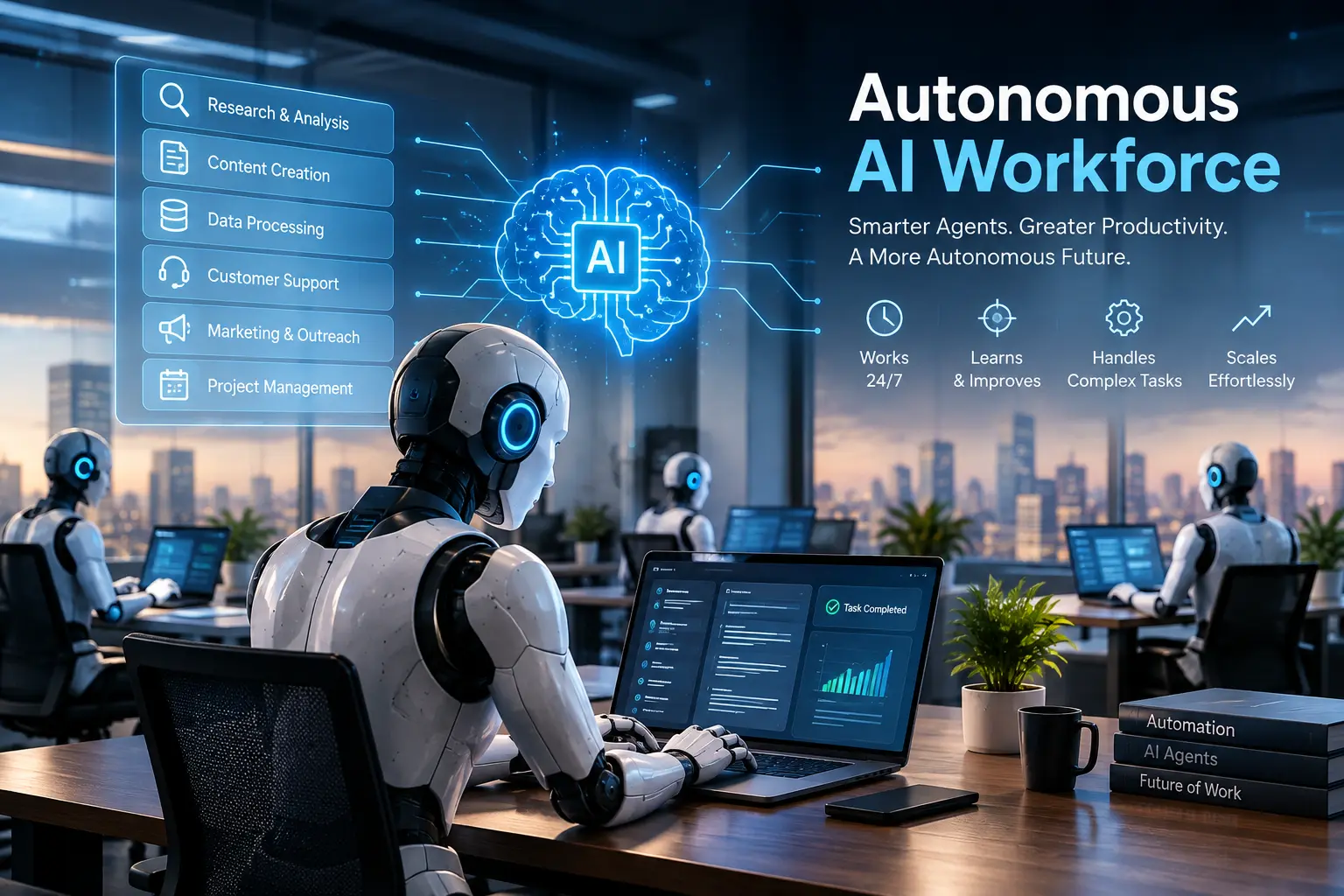

Enterprise software has spent the last decade automating single tasks, like a chatbot that answers a question or a script that moves data between two systems. That ceiling has now been broken. Major platforms are shipping AI specialists that hold entire job roles, triaging tickets, running root-cause analysis, resolving HR cases, and escalating to a person only when the situation genuinely calls for one. This layer of technology is known as the autonomous AI workforce, and it is quickly becoming one of the most searched and most funded categories in enterprise AI.
What Is an Autonomous AI Workforce?
An autonomous AI workforce is a group of AI-powered digital workers, often called AI agents or AI specialists, that plan, decide, and carry out multi-step tasks on a person’s behalf with little or no human intervention. Rather than being limited to a single narrow task, each agent is built around a defined job role, complete with the permissions, workflows, and institutional context a human employee in that role would need.
The distinction from earlier automation comes down to autonomy combined with scope. A traditional bot follows a fixed script and stops when the script ends. A chatbot answers a question and waits for the next one. An autonomous AI workforce, by contrast, can pick up a case, investigate it, take corrective action across several systems, and involve a person only when the decision requires judgment a machine should not make alone.
How Big Is This Shift, Really?
The pace of enterprise adoption backs this up. Gartner forecasts that 40% of enterprise applications will include task-specific AI agents by the end of 2026, up from under 5% in 2025, and projects that agentic AI could drive close to a third of all enterprise application revenue by 2035. That is not a niche upgrade cycle. It is a rewrite of how enterprise software gets built and sold.

Autonomous AI Workforce vs. AI Agents vs. Chatbots
It helps to think of this as an evolution across three stages.
Stage 1: Chatbots and Generative AI
Good at summarizing, drafting, and answering questions, but unable to take action on their own.
Stage 2: AI Agents
Capable of narrow, task-level actions such as submitting a form, looking up a record, or sending a notification. These typically fall into two categories, copilots that keep a human in the loop for every decision and autopilots that act with limited human sign-off.
Stage 3: Autonomous AI Workforce
AI specialists assigned to a complete role, with the enterprise context, security guardrails, and cross-system permissions needed to carry a workflow from start to finish rather than handling one slice of it.
The distinction matters when evaluating vendors or planning a build. “Workforce” implies a team of role-based agents working together toward an outcome, not a single point solution bolted onto one application.
The Building Blocks of an Autonomous AI Workforce
Whether a company buys a platform-native solution or builds custom agents, the same core components tend to show up.
- A large language model (LLM) that understands instructions and generates reasoning and content.
- A system prompt or role definition that shapes how the agent behaves and what success looks like for its job.
- Memory, both short- and long-term, so the agent does not start from zero on every interaction.
- A feedback loop that lets the agent improve based on outcomes and human corrections.
- Tools and integrations, such as APIs, workflow permissions, and system access, that let the agent take real action instead of only describing what should happen.
At scale, individual agents are usually organized into a multi-agent system, arranged as an assembly line with sequential handoffs, a leader-driven hierarchy where one orchestrating agent delegates to others, or an omni-directional setup where agents and humans work side by side. None of this is possible without the underlying model doing the reasoning, which is why it is worth understanding what the main goal of generative AI actually is before evaluating any agent platform. The agents built on top of it inherit both its strengths and its limitations.
Building an Autonomous AI Workforce: Development & Consulting
Standing up an autonomous AI workforce is rarely a simple plug-in. Most organizations either build custom agents in-house, hire a specialist partner, or bring in consultants to manage the transformation end to end.
Large organizations with complex compliance and integration requirements often turn to enterprise AI agent development services to get agents built with the governance, audit trails, and system access that regulated environments demand. Smaller and mid-market companies are more likely to look for custom AI agent development services tailored to one specific workflow rather than a full platform rollout.
Deciding whether to build, deploy, or govern agents in-house is genuinely difficult, which is why many companies skip the DIY route entirely and bring in agentic AI consulting and implementation partners who have already solved the governance and change-management challenges elsewhere.
The Business Side: AI Automation Agencies
Wherever a new technology creates measurable ROI, an agency layer emerges to help businesses adopt it faster. A growing number of consultancies and boutique shops now exist purely to design, build, and manage autonomous agents for their clients.
Reviewing AI automation agency success stories from 2026 is a practical way to see what a working engagement looks like end to end, from the first workflow audit to a live deployment. Anyone considering starting or pivoting an agency into this space should research the best niches for AI automation agencies in 2026 before committing to a vertical, since industries are not equally ready to adopt agent-based automation yet. For agencies whose strength is internal operations rather than customer-facing AI, a workflow automation agency model, focused on connecting existing tools through agentic logic, is often the faster path to revenue.
Where Autonomous Agents Get Deployed: Use Cases by Function
Once the infrastructure and the right partner are in place, the real question is which parts of the business benefit first. A handful of functions are leading adoption.
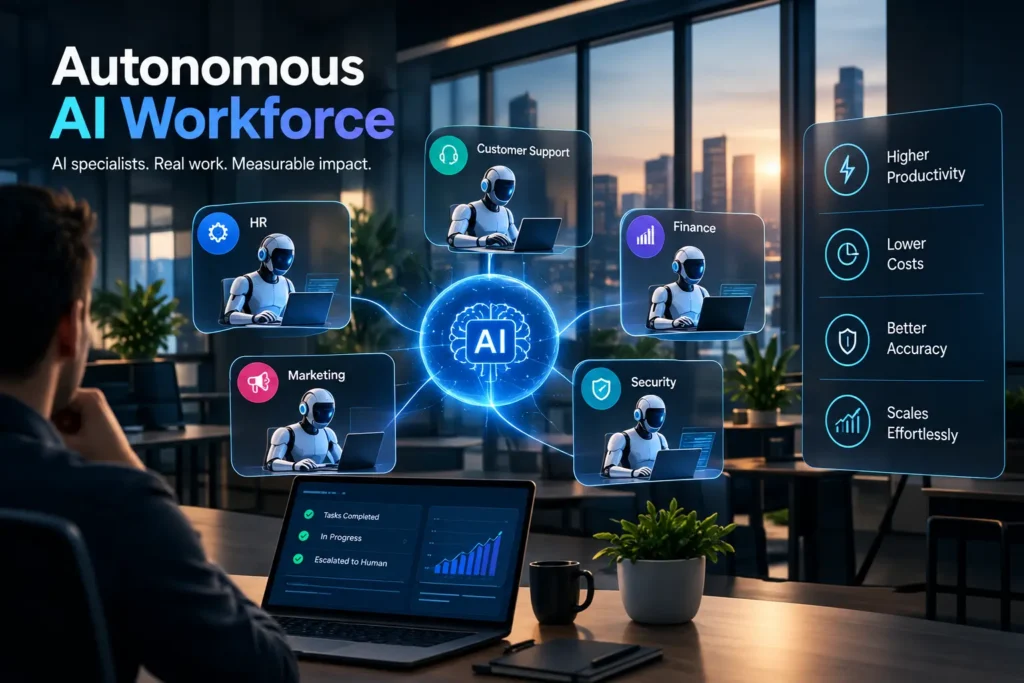
Customer-facing teams were early movers, with CX agents now handling first-line support, sentiment triage, and case routing so human agents only see the cases that genuinely need a person. In finance, agentic finance applications have moved beyond simple reporting automation into agents that reconcile accounts, flag anomalies, and initiate approved transactions. Marketing teams are asking a related question from a different angle, wondering what is agentic marketing and how it differs from the marketing automation they already run. In security, agentic AI for URL fraud detection is being used to identify phishing infrastructure and malicious domains faster than manual review ever could.
Why Enterprises Are Moving Fast
A few forces are pushing adoption faster than a typical enterprise software cycle.
- Governance has caught up: Platforms now ship AI specialists that inherit existing permissions, approval chains, and compliance rules instead of operating as black boxes.
- The ROI case is concrete: Companies running AI specialists on high-volume, repetitive workflows, such as IT tickets, HR cases, and vulnerability triage, are reporting measurable drops in resolution time and cost per case.
- Capacity constraints are real: An autonomous AI workforce can absorb sudden demand spikes without a hiring cycle, which matters in industries with volatile ticket or case volume.
This urgency is echoed in labor-market research as well. McKinsey’s analysis of generative AI and the future of work in America estimates that with generative AI, automation could touch nearly 30% of hours currently worked in the U.S. economy by 2030, up from roughly 22% without it. That scale of change is exactly why enterprises are treating agent strategy as a near-term priority rather than a future experiment.
Challenges to Plan For
Adoption is not without friction. Businesses building an autonomous AI workforce still need to solve for the following.
- Governance and auditability: Every autonomous action needs a trail a compliance team can review.
- Scope creep: Agents that are too broadly scoped become harder to trust and harder to debug when something goes wrong.
- Change management: Teams need to learn when to trust an AI specialist’s output and when to escalate, which takes onboarding just like a new hire would.
Frequently Asked Questions
Is an autonomous AI workforce the same as RPA?
No. Robotic process automation follows fixed, rule-based scripts. An autonomous AI workforce uses AI agents that reason, adapt, and make judgment calls within a defined scope, closer to a digital employee than a script.
Do businesses need to build agents from scratch to get an autonomous AI workforce?
Not necessarily. Many enterprise platforms now ship prebuilt, role-specific AI specialists for common functions like IT support and HR case management, while custom development is reserved for more specialized workflows.
What is the difference between a copilot and an autopilot agent?
A copilot works alongside a human and requires sign-off before acting. An autopilot can act independently within its permissions and escalates to a human only when it reaches the edge of its authority.
Key Takeaways
- An autonomous AI workforce is not a single product. It is a layer that sits on top of existing generative and agentic AI technology, wrapped in enough governance and role definition to be trusted with real work.
- The core distinction from earlier automation is autonomy plus scope, since agents are assigned full job roles instead of single tasks.
- Whether a business builds custom agents, buys a platform-native solution, or hires a development or consulting partner, the fundamentals stay the same. Define the role clearly, give the agent the right context and permissions, and measure the outcome the way you would for any new hire.
- Governance, scope, and change management are the real adoption bottlenecks, not the underlying AI capability itself.