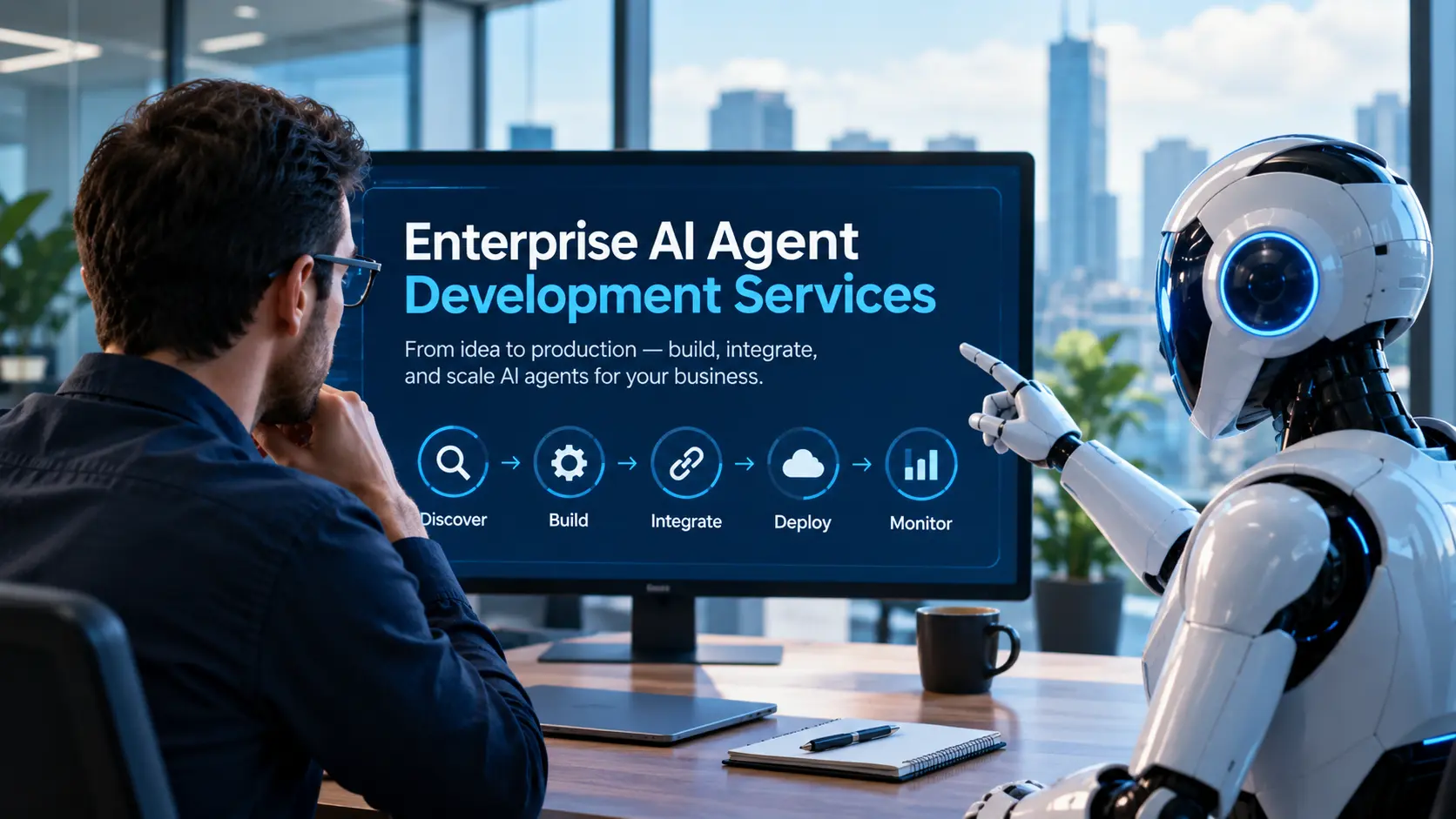

Enterprise AI agent development services are the discovery, engineering, integration, and governance work needed to turn an AI agent from a demo into a system that runs safely inside a company’s real infrastructure, connected to its actual data, tools, and approval chains. They cover everything between “we like the idea of an AI agent” and “this agent is live in production, monitored, and accountable to an audit trail.”
This guide breaks down what these services typically include, what they cost in 2026, when it makes sense to build versus buy, and what separates a partner who can actually ship an agent from one who can only demo one.
What Are Enterprise AI Agent Development Services?
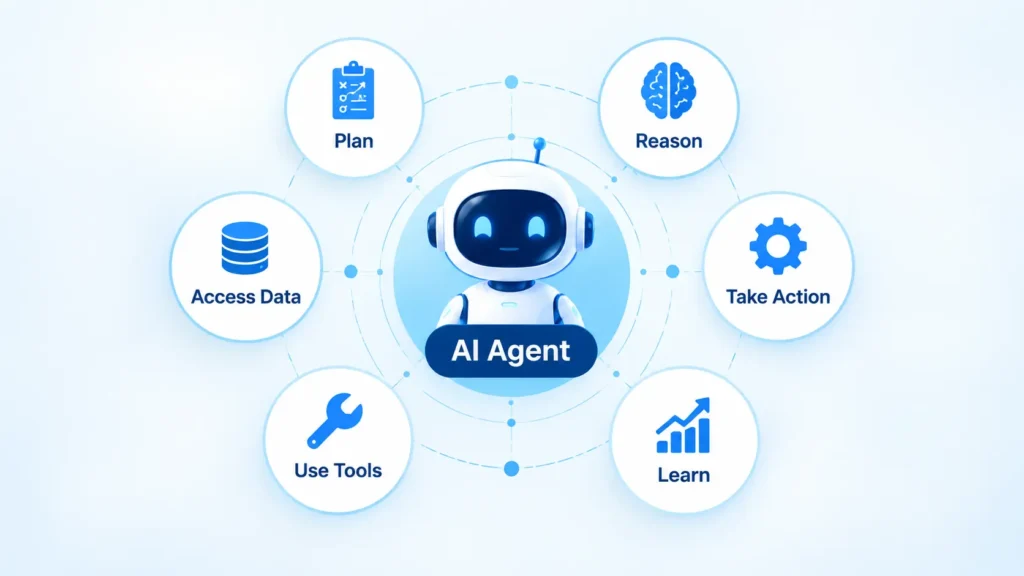
At the enterprise level, an AI agent is not a chatbot with a system prompt. It is a role-based system that reasons over a task, calls internal tools and APIs, retrieves and reasons over company knowledge, and acts within permissions a security team has explicitly granted it. Building that safely, inside a large organization’s compliance and integration constraints, is a different job than building a consumer AI feature. That is exactly the gap enterprise AI agent development services are built to close, sitting one step below the broader autonomous AI workforce strategy a company might be pursuing and one step above simply subscribing to an off-the-shelf tool.
Development partners in this space range from boutique engineering shops with deep agentic-framework experience to global systems integrators who embed agent work inside larger digital transformation programs. Both models exist because enterprise agent projects usually need two things at once: frontier AI expertise and the patience to work inside legacy systems, security reviews, and change-management processes that were never built with autonomous software in mind.
What’s Included in Enterprise AI Agent Development Services
A production-grade agent build tends to move through the same core phases, regardless of which vendor delivers it.
Discovery and Use-Case Feasibility
The engagement typically opens with a discovery phase that maps existing workflows, evaluates which tasks are genuinely well suited to an agent, and defines a clear task boundary rather than a vague ambition. This step also decides where a single-purpose agent is enough and where the use case actually needs a multi-agent system working across departments.
Architecture and Framework Selection
Next comes choosing the orchestration layer, since this decision shapes everything downstream. Common choices in 2026 include Microsoft Copilot Studio for Microsoft-first environments, LangGraph and CrewAI for open-source, framework-agnostic builds, and the Claude Agent SDK for teams that prioritize reasoning quality and regulated-industry safety needs. Many enterprise builds also standardize on open interoperability protocols, such as MCP for tool connections and A2A for agent-to-agent communication, so the system is not locked to one vendor’s ecosystem.
Data and Knowledge Integration
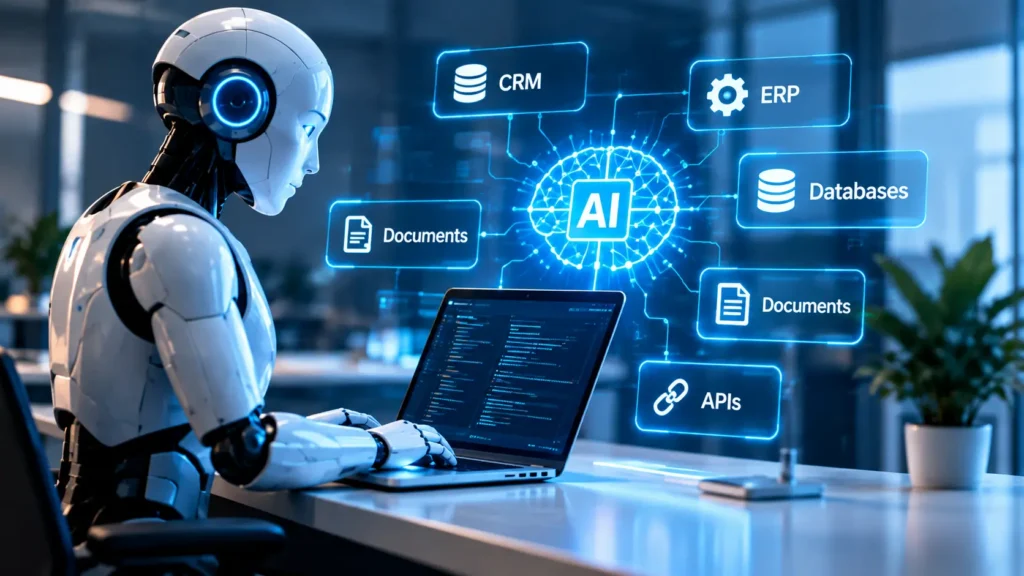
An agent is only as useful as what it can see. This phase connects the agent to structured systems like CRM, ERP, and internal databases, plus unstructured sources such as policy documents and past case history, usually through retrieval-augmented generation or a knowledge graph. This is also where access controls get defined, so the agent can only retrieve and act on data its role is actually permitted to touch.
Build, Integration, and Testing
The agent’s reasoning logic, tool bindings, and guardrails get built and connected to real enterprise systems here, followed by testing against both expected scenarios and edge cases such as ambiguous requests, incomplete data, or slow downstream systems. Mature vendors run this through the same CI/CD pipelines used for other enterprise software, with version control and automated security scanning applied to agent changes just as they would be to any other code release.
Governance, Security, and Compliance
This is the phase that most separates enterprise-grade work from a hobbyist build. It includes audit trails for every agent decision and tool call, role-based access control, human-in-the-loop checkpoints for high-risk actions, and documentation a compliance or risk team can actually review. Under regulations like the EU AI Act, this kind of documented governance is no longer optional for high-risk agentic deployments, it is a compliance requirement.
Deployment and Continuous Monitoring
Once live, the agent is registered in an internal agent registry with a clear owner, version, and approved capability list, then monitored for accuracy, escalation patterns, and drift as business rules and source systems change. Reputable vendors treat this as an ongoing engagement, not a one-time handoff, since an agent’s behavior can shift as the systems around it change.
How Much Do Enterprise AI Agent Development Services Cost?
Pricing scales with scope and system complexity rather than with the AI model itself, since most of the cost sits in integration, governance, and testing.
| Agent Type | Typical Cost Range |
|---|---|
| Single-purpose agent (support triage, lead qualification) | $50,000 to $70,000 |
| RAG-based agent with enterprise knowledge integration | $70,000 to $250,000 |
| Multi-agent orchestrated workflow system | $250,000 to $750,000+ |
Vendors serving Fortune 500 and highly regulated clients, including the large systems integrators, generally price at the higher end of these ranges or work on custom enterprise contracts, since their engagements include heavier compliance documentation and integration with legacy platforms like SAP, Oracle, or mainframe systems.
Enterprise AI Agent Development vs. Off-the-Shelf Agent Platforms
Not every company needs a custom build. Platforms such as Salesforce Agentforce, IBM watsonx Orchestrate, Microsoft Copilot Studio, and Google Vertex AI Agent Builder now ship pre-built, role-specific agents that work well when a company’s needs sit inside that platform’s existing ecosystem.
A custom AI agent development services approach tends to make more sense when a workflow spans multiple systems that no single platform covers cleanly, when the use case is specific enough that a generic agent template does not fit, or when governance requirements demand full visibility into how the agent reasons and where its data comes from. Many enterprises land on a hybrid approach, using a platform’s native agents for common functions while commissioning custom development, sometimes through agentic AI consulting and implementation, for the workflows that actually differentiate the business.
Why the Production Gap Matters for Buyers
The market is moving fast, but adoption numbers can be misleading if taken at face value. Gartner forecasts that 40% of enterprise applications will include task-specific AI agents by the end of 2026, up from under 5% in 2025. At the same time, McKinsey’s most recent State of AI survey found that while 88% of organizations now use AI in some capacity, only a minority have actually scaled an agentic system into full production.
That gap is exactly why the discovery, governance, and testing phases described above matter more than the choice of AI model. A partner who can demo an agent in a sales call is common. A partner who can get that same agent through a security review, into production, and monitored six months later is the one actually worth paying for.
How to Choose an Enterprise AI Agent Development Partner
A short checklist to run through before signing a statement of work.
- Ask for a production reference, not a demo. A partner should be able to walk through a live deployment that mirrors your industry and compliance needs, not just a proof of concept.
- Confirm their governance approach in detail. Ask exactly how they handle audit trails, access control, and human checkpoints for high-risk actions, and ask to see their evaluation methodology before signing.
- Understand their deployment model. Confirm whether they can support your required environment, whether that is cloud, on-premises, or a hybrid setup bound to a private VPC.
- Check framework flexibility. A partner locked into one orchestration framework may not be the best fit if your environment already standardizes on another.
- Ask how they measure ROI. A credible partner should have a concrete, repeatable way to prove the agent is doing its job, not just anecdotal client feedback.
FAQs
What is the difference between enterprise AI agent development and building a chatbot?
A chatbot answers questions within a conversation. An enterprise AI agent takes multi-step action across real systems, using defined permissions, and typically includes governance, audit trails, and monitoring that a chatbot project usually does not require.
How long does an enterprise AI agent development project take?
A single-purpose agent can often go from discovery to deployment in a few months, while a multi-agent orchestrated system spanning several departments can take considerably longer, largely due to integration and governance review rather than the AI development itself.
Do enterprise AI agent development services include ongoing support after launch?
Reputable vendors include monitoring, performance tracking, and periodic updates as part of the engagement, since an agent’s accuracy can drift as the underlying business rules and connected systems change over time.
Key Takeaways
- Enterprise AI agent development services cover discovery, architecture, data integration, build and testing, governance, and post-launch monitoring, not just the AI model itself.
- Cost typically ranges from roughly $50,000 for a single-purpose agent to $750,000 or more for a multi-agent orchestrated system, with governance and integration work driving most of the cost.
- Off-the-shelf platforms can cover common use cases, while custom development tends to win out for cross-system workflows and heavier governance requirements.
- Most organizations are still experimenting rather than running agents in production at scale, which makes a partner’s governance and evaluation practices more important than how impressive their demo looks.