
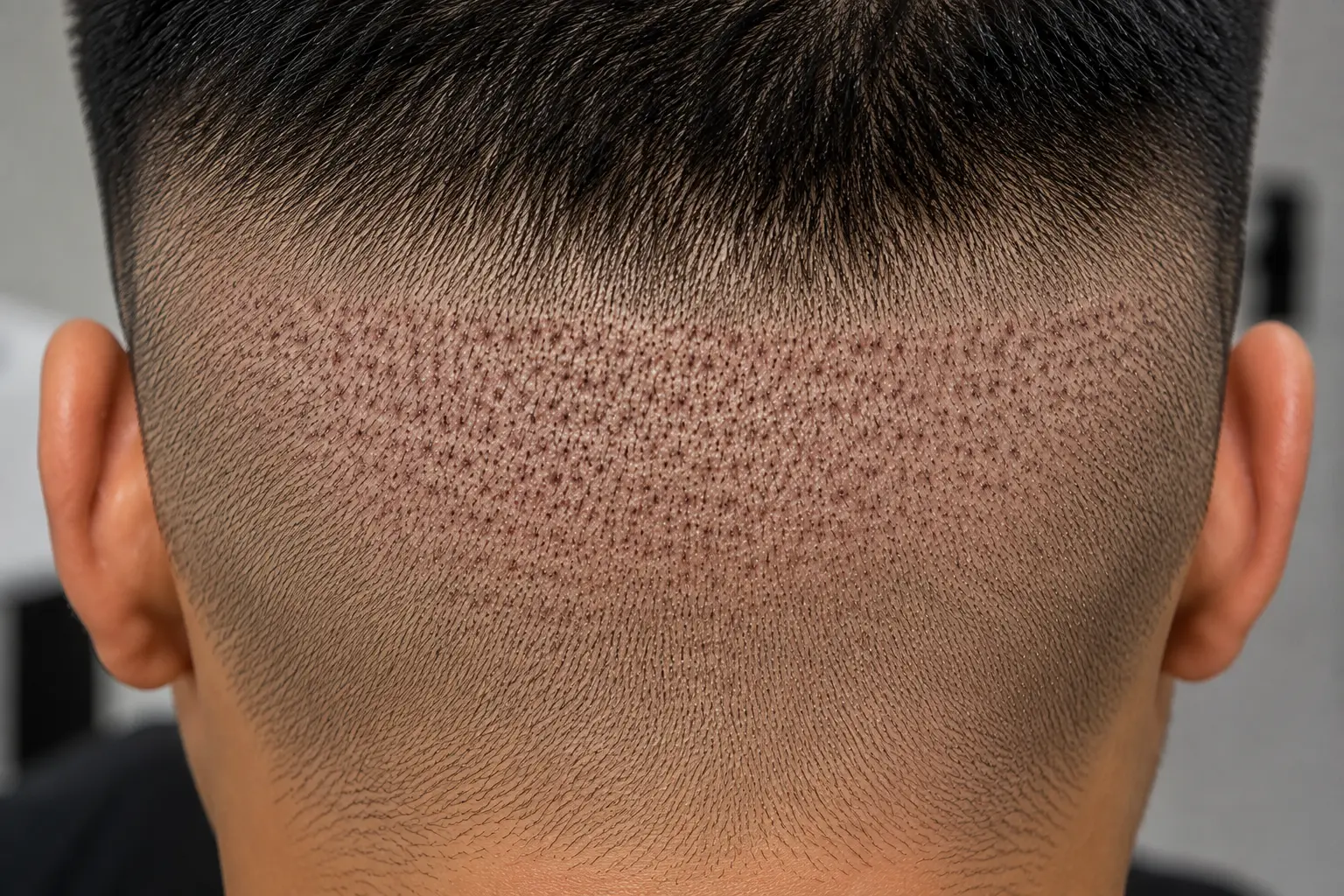

FUE hair transplant scars are real, even though the procedure is often marketed as scarless. Every follicle removed during extraction leaves a tiny round mark behind, usually under 1 millimeter wide. These scars are genuinely much harder to notice than the single linear scar left by FUT, but harder to notice is not the same thing as absent, and understanding the real difference matters before choosing a technique.
What FUE Hair Transplant Scars Actually Look Like
FUE uses a small circular punch tool, typically 0.6 to 1.0 millimeters in diameter for standard punches, to remove individual follicles from the donor area one at a time. Each extraction leaves a tiny, round scar behind. As these heal, they usually appear as small white or skin colored dots scattered across the donor zone. Since hundreds or even thousands of follicles may be removed in a single session, the donor area ends up with a large number of these tiny marks, just spread out rather than concentrated in one line.
Are FUE Scars Really Invisible? The Scarless Myth
This is the part most marketing skips entirely, and it is genuinely counterintuitive. Follicle for follicle, FUE actually leaves more total scar surface area in the donor zone than FUT does for the same number of grafts, according to the International Society of Hair Restoration Surgery. With FUE, the relationship is direct, one follicle removed equals one scar, so the total number of donor scars scales directly with the number of grafts taken. FUT avoids this entirely, since the tissue that would have become individual FUE scars is removed as part of one continuous strip instead.
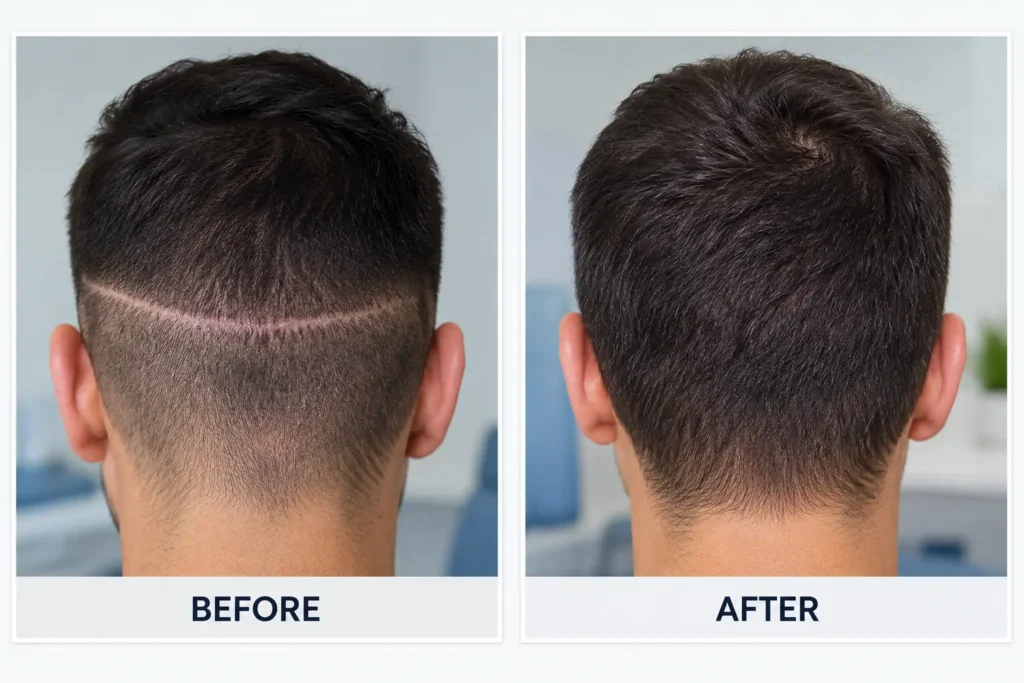
So why does FUE look so much less noticeable? The human eye is drawn to patterns. A single continuous line stands out immediately, while hundreds of small, randomly scattered dots are far harder for the eye to register as a pattern at all, even though the actual scarred surface area may be larger. FUE is not scarless, it is simply much better camouflaged.
FUE Scars Compared to FUT Scars
| Factor | FUE | FUT |
|---|---|---|
| Scar type | Many small, round dot scars | One linear scar |
| Total scarred area | Larger, spread across the donor zone | Smaller, concentrated in one line |
| Visibility with short hair | Low, hard to detect as a pattern | Higher, a single line is easy to spot |
| Shaving required | Yes, in the donor area | Usually not required |
Cost, recovery time, and graft survival also differ between the two beyond scarring alone, which is really a question of FUE versus FUT as complete techniques, not just their donor marks. Much of FUT’s reputation for a thin, hard to detect line comes down to trichophytic closure, where the surgeon trims the wound edge so hair can grow directly through the healed scar.
Scarring With DHI and Sapphire FUE
Since DHI uses the same extraction method as standard FUE, donor scarring works the same way, small round dot scars from the punch tool, regardless of which implantation tool places the graft afterward. Sapphire FUE follows the same extraction pattern too, though its narrower, V-shaped incision at the recipient site may leave a slightly smaller mark there compared to a standard steel blade.
FUE Scar Healing Timeline
Healing follows a fairly predictable pattern. In the first 3 days, the donor area shows redness, mild swelling, and small scabs. Between days 4 and 7, those scabs begin flaking off naturally, and mild itching is common as the skin heals underneath. By week 2, most scabs are gone and the tiny dot scars become visible, though not yet fully settled. Over the following weeks, the marks continue to fade and blend with the surrounding skin tone, and by 3 months most patients see the donor area looking close to fully healed, with the dot scars minimal and easy to miss.
Rare Complications: Keloids After FUE
Keloid scarring, where scar tissue grows beyond the original wound, is rare after FUE and more commonly associated with FUT. A documented case published in the Journal of Cutaneous and Aesthetic Surgery described a patient who developed multiple raised, dot shaped keloids at FUE donor sites, an unusual presentation reported only once before in the medical literature, according to the case report on PubMed Central. A few factors raise the risk of this kind of complication.
- A personal or family history of keloid scarring
- Darker skin tones, which carry a higher documented risk
- Larger punch tools used to harvest many follicles quickly
- Poor aftercare during the early healing period
Surgeons can reduce this risk by choosing smaller micro punch tools, screening for personal or family keloid history beforehand, and treating any early signs of raised, itchy scarring promptly.
How to Treat or Conceal FUE Scars
For patients who do notice visible donor scarring, a few real options exist. Scalp micropigmentation deposits pigment into the scalp to visually mimic hair density and disguise the dot pattern, an approach the International Society of Hair Restoration Surgery also recognizes as a legitimate camouflage option. Laser treatments can improve skin texture and stimulate collagen production around the scar. In some cases, healthy grafts can even be implanted directly into older scar tissue to add coverage, provided the area has enough blood supply to support new growth.
Summary
FUE hair transplant scars are real, small, round marks left at each extraction site, and despite common marketing language, FUE is not truly scarless. Research shows FUE can actually leave more total scarred surface area than FUT for the same graft count, it simply scatters that area into a pattern the eye struggles to notice, unlike FUT’s single visible line. Healing typically resolves within about 3 months, keloid complications are rare but documented, and options like scalp micropigmentation exist for anyone who wants to further conceal visible scarring.
Frequently Asked Questions
Is FUE really scarless?
No. FUE leaves small, round scars at every extraction site, and research shows the total scarred area can be larger than FUT’s for the same graft count. It is simply far less noticeable due to how scattered and small each mark is.
How long does it take for FUE scars to heal?
Most scabbing resolves within 7 to 10 days, and the donor area typically looks close to fully healed by around 3 months, with the tiny scars fading further over time.
Can FUE scars be completely removed?
Not completely, but they can be made far less noticeable through options like scalp micropigmentation, laser treatment, or grafting healthy follicles directly into the scarred area.
References
- International Society of Hair Restoration Surgery. Is FUE Scarless?
- Alhamzawi NK. Keloid Scars Arising after Follicular Unit Extraction Hair Transplantation. Journal of Cutaneous and Aesthetic Surgery, 2020.
- International Society of Hair Restoration Surgery. Scalp Micropigmentation.
Disclaimer: This article is based on peer reviewed medical literature and professional hair restoration sources, offering an evidence based look at FUE hair transplant scars for general informational purposes only. It is not a substitute for professional medical advice.