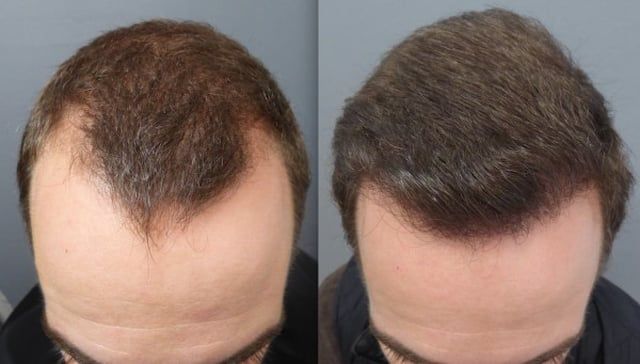
FUE Hair Transplant : Cost, Steps and Recovery
FUE hair transplant is a surgical method that removes individual hair follicles from a dense area of the scalp and moves them to a thinning or bald area. Surgeons use tiny punch tools instead of cutting a strip of skin, so the procedure leaves no linear scar.
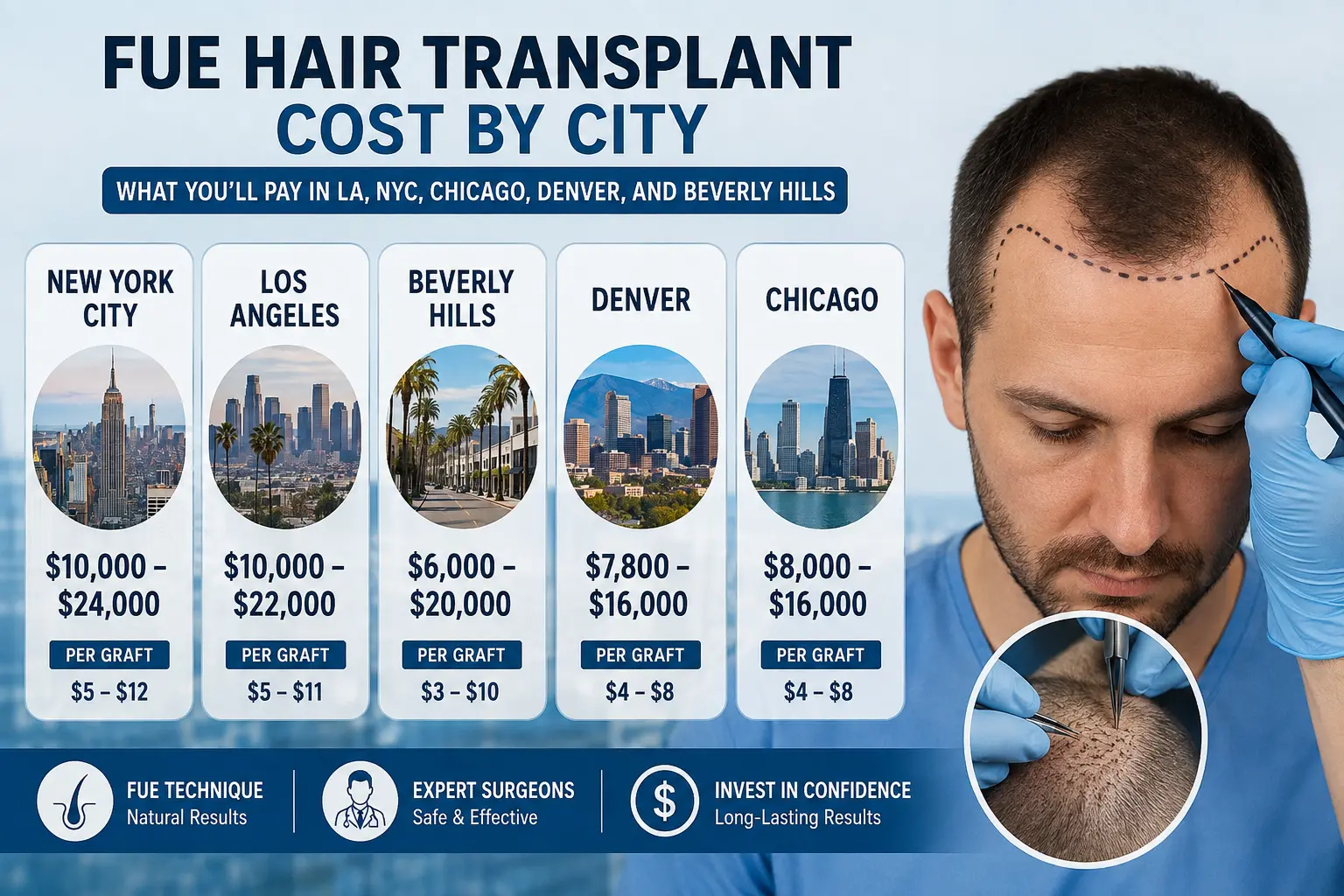
Most patients pay between $4,000 and $15,000 for a single session, and visible new growth usually starts around 3 to 4 months after surgery.
What Is FUE Hair Transplant
FUE stands for follicular unit extraction, sometimes called follicular unit excision. The surgeon extracts hair follicles one at a time using a micro punch tool that ranges from 0.7 to 1.2 millimeters wide. Each follicular unit is a small natural cluster containing 1 to 4 hairs. Once removed, these units get placed into small incisions made in the balding or thinning area.
This approach replaced the older strip harvesting method for most patients because it avoids a visible line of scarring and allows a shorter hairstyle afterward, according to the International Society of Hair Restoration Surgery. The technique still requires real surgical skill. A rushed or careless extraction can damage follicles before they even reach the recipient area, so the experience of the surgeon matters as much as the tools used.
How the Procedure Works
The donor area is usually the back and sides of the scalp, since hair there tends to resist the hormone that causes pattern baldness. Surgeons refer to this reliable donor zone as the safe donor area. Harvesting outside of it raises the risk of visible thinning later, since hair taken from outside that zone may not be permanent.
The surgeon extracts follicles from the donor zone one unit at a time, examining and sorting each one by hair count before placement. Recipient sites are then created with a fine blade or needle. Some clinics use a sapphire crystal blade instead of standard steel for this step, since it holds its edge longer and creates a narrower incision. This variation is often marketed as sapphire FUE, though the rest of the procedure remains identical to standard FUE. Placement angle and direction matter here because they determine how natural the final hairline looks. A skilled surgeon studies the natural growth pattern of the surrounding hair and matches it, rather than placing every graft at the same angle.
FUE vs FUT: Key Differences
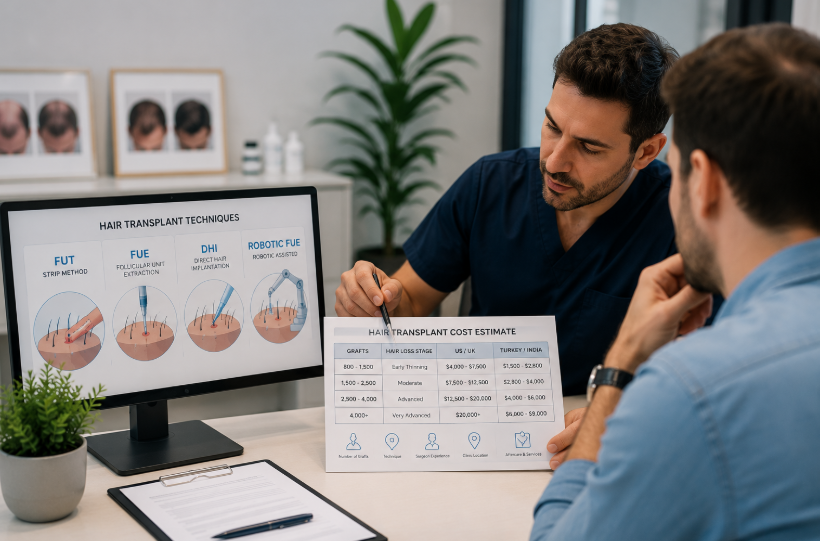
FUT, or follicular unit transplantation, is the older strip method. It removes a long strip of scalp tissue, closes the wound with stitches, and separates the strip into individual grafts under a microscope. Both techniques move real hair follicles. The difference is how the donor hair gets collected.
| Factor | FUE | FUT |
| Donor scarring | Tiny dot scars spread across the donor area | One linear scar across the back of the head |
| Recovery time | Faster, often 3 to 5 days | Slower, 1 to 2 weeks |
| Short hairstyles after surgery | Usually possible | Scar may show with very short hair |
| Procedure length | Longer, since grafts are removed one by one | Shorter harvesting time |
| Typical cost per graft | Higher | Lower |
| Best suited for | Smaller to mid size sessions, active lifestyles | Larger sessions where cost per graft matters more |
There is no single best choice between the two methods. A patient who values a scar free look and plans to keep hair short benefits more from FUE. A patient focused on lowering cost for a large session may still choose FUT. A peer-reviewed review published in the Journal of Maxillofacial and Oral Surgery notes that FUE carries a longer learning curve and a higher risk of follicle damage during extraction, so surgeon skill affects FUE outcomes even more than it affects FUT outcomes. Read our article Fue vs Fut for detailed explanation.
The FUE Procedure: Step by Step
A full session generally follows the same core stages, though small details vary by clinic.
Before the Procedure
The surgeon reviews the donor area, discusses the hairline design, and confirms the patient is medically fit for surgery. Blood tests and a scalp examination are common at this stage. Patients are usually told to stop blood thinners and alcohol for 1 to 2 weeks before surgery, since both increase bleeding during extraction and can make grafts harder to place cleanly. Surgeons also ask patients to avoid a haircut right before the appointment, since seeing the hair at its natural length helps with planning a hairline that matches how it actually falls and grows.
Outlining the Surgical Area and Confirming Patient Goals
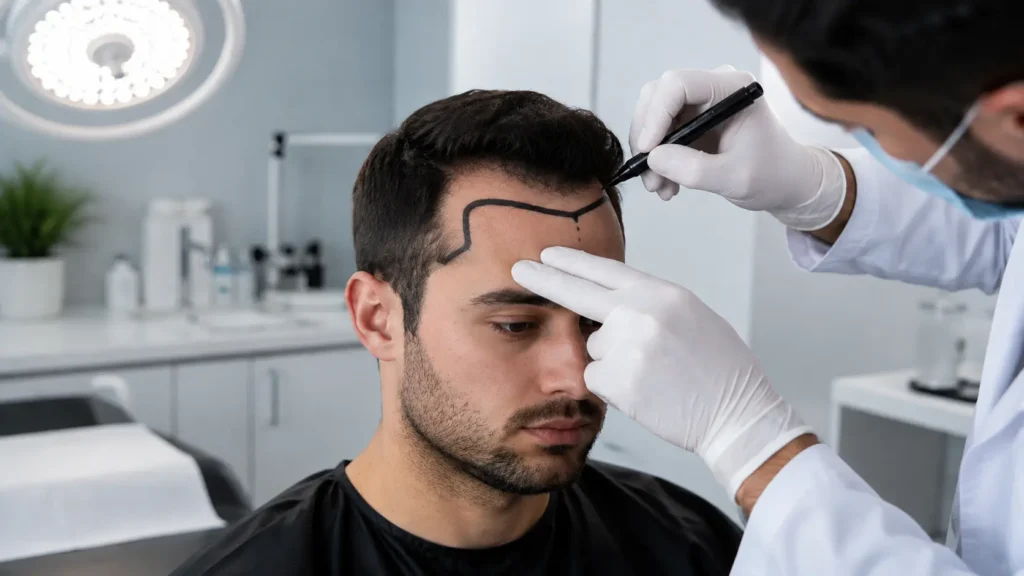
Before any cutting begins, the surgeon marks out the donor and recipient areas and finalizes the hairline design directly on the scalp. This step also includes reviewing the plan with the patient and confirming they agree with where hair will be placed. This matters more than it sounds. A patient who wants coverage in the crown but ends up with a plan that only addresses the hairline will walk away unhappy even if the surgery itself goes well, so getting sign off on the marked areas before surgery starts is what protects patient satisfaction later. Some surgeons also test a few grafts against the marked recipient sites first to confirm fit before committing to the full plan.
What Happens During Surgery
Numbing the Scalp
The scalp is numbed with local anesthesia so the patient stays awake but feels no pain during extraction and placement. Local anesthesia is preferred over general anesthesia for this procedure because it lets the patient sit comfortably for hours without the added risks that come with full sedation.
Extracting and Storing the Grafts
The surgeon extracts follicular units from the donor area one at a time using the micro punch tool. Working graft by graft is slower than the older strip method, but it is exactly why FUE avoids leaving one long scar. As grafts come out, they go into a cooled holding solution, since a follicle is living tissue and starts losing viability the longer it sits outside the body.
Creating Recipient Sites and Placing Grafts
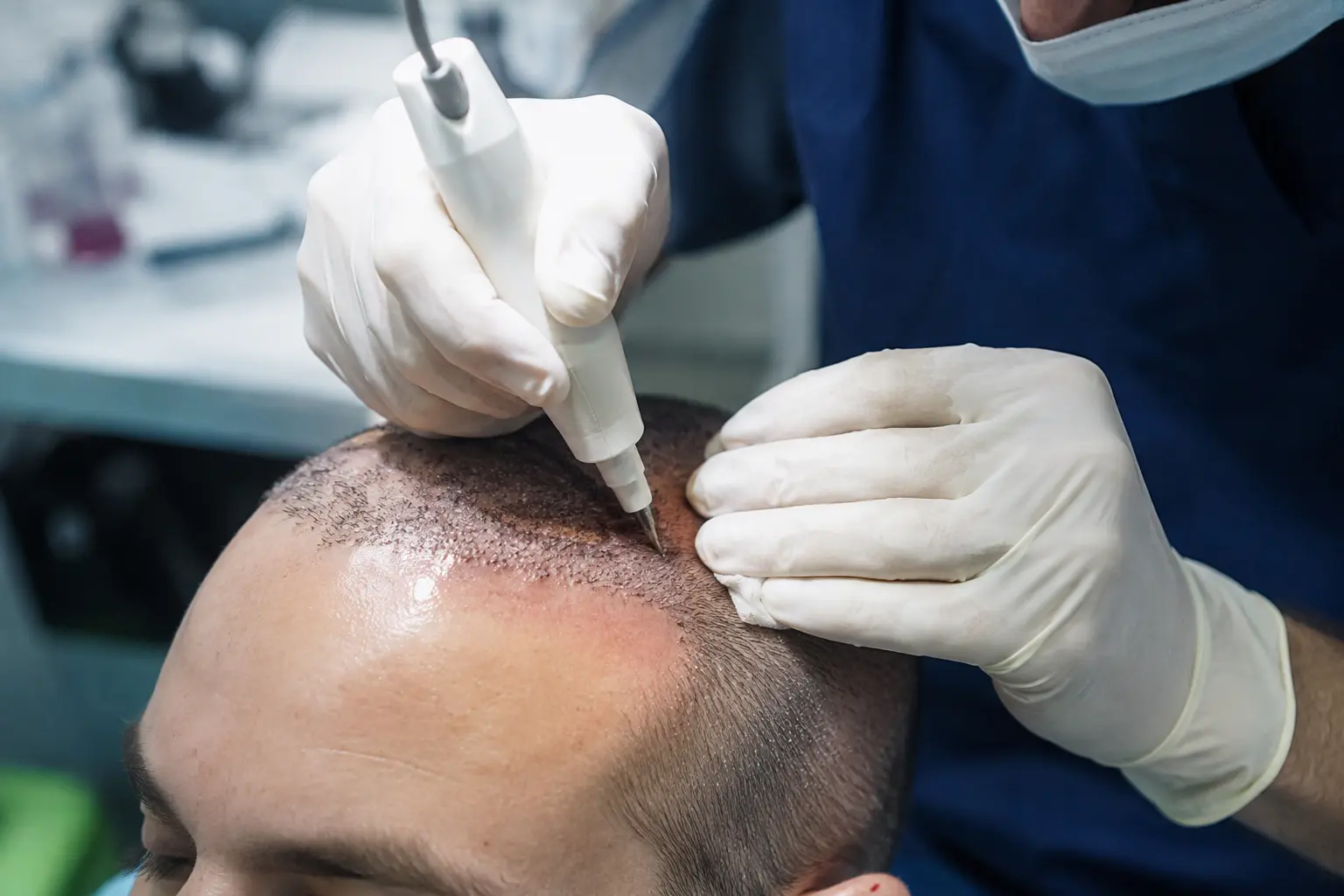
Once enough grafts are ready, the surgeon creates small incisions in the recipient area at a precise angle. Getting this angle right matters because hair naturally grows in a specific direction, and grafts placed against that direction can end up looking unnatural even after they grow in fully. Each graft is then placed into a recipient site by hand or with a specialized tool, usually by trained staff working under the surgeon’s supervision, since careless handling at this stage can damage a graft that survived extraction without issue.
A typical session runs 2 to 4 hours, though larger cases can take a full day or span 2 consecutive days.
Recovery Timeline
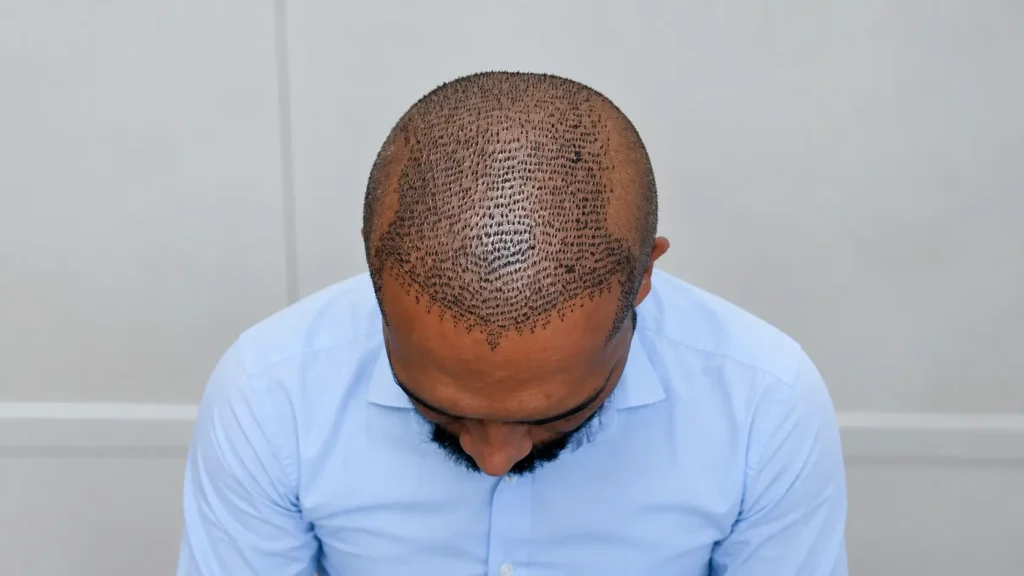
In the first 3 days, you will notice mild swelling, redness, and small scabs at both the donor and recipient sites. This is simply your scalp healing, not a sign that anything went wrong. Gently rinsing your scalp the way your surgeon shows you, sleeping with your head slightly elevated, and keeping the area out of direct sun all help those scabs clear faster. Most scabs shed within the first week, though it is best to hold off on strenuous exercise and swimming during this period, since sweat and increased blood flow can disturb the healing sites.
Between weeks 2 and 4, do not be alarmed if some of the transplanted hair falls out. This is called shock loss, and it happens because the hair shaft sheds while the follicle underneath stays in place and rests before starting a new growth cycle. New growth becomes visible around month 3 to 4, and hair keeps thickening from there. Most patients see their full result somewhere between month 6 and 12.
FUE Cost in the USA
FUE typically costs between $4,000 and $15,000 per session in the United States. Larger cases involving multiple sessions can reach $50,000 or more over time. Because most insurance plans treat hair transplants as cosmetic, patients usually pay out of pocket. What actually drives hair transplant cost goes beyond FUE alone, since technique, graft count, and location all interact differently across FUT and DHI too. Hair transplant cost in the US tends to run highest of any major market, largely due to surgeon fees and facility overhead that lower cost countries do not carry.
What Affects the Cost
- Number of grafts needed to cover the thinning or bald area.
- Surgeon experience and reputation.
- Clinic location and regional cost of living.
- Whether the case requires one session or several.
- Technology used, such as manual, motorized, or robotic extraction.
Clinics that charge per graft usually price each graft somewhere in the range of $4 to $8, though this varies widely by surgeon and city. In fact, FUE cost shifts noticeably from one US city to another, so where you have the procedure done matters almost as much as which clinic you choose. Getting a written quote after an in person or virtual consultation is the only reliable way to know actual cost for a specific case.
FUE Cost Around the World
Cost also varies enormously by country. Patients researching international options often find hair transplant cost in Turkey running a fraction of US prices due to flat package pricing and lower regional costs of care. Hair transplant cost in Pakistan tends to follow a similar pattern for the same reasons. Hair transplant cost in India is often comparably low too, though verifying a clinic’s accreditation and surgeon credentials matters more than chasing the lowest possible price, especially when follow-up care after travel becomes harder to manage. Female patients researching Turkey specifically should know that female hair transplant in Turkey often favors different techniques than a typical male session, since diffuse thinning changes which method actually works best. Cost for women also carries its own drivers beyond country alone, covered in full in our guide to female hair transplant cost.
Areas This Procedure Can Treat
Most people associate this technique with the scalp, but it works anywhere hair follicles can be harvested and relocated. Surgeons commonly use it for the following areas.
- Scalp, for typical male and female pattern hair loss.
- Eyebrows, to restore thinning or sparse brows.
- Beard and mustache, to fill in patchy facial hair.
- Body areas such as the chest, in cases where scalp donor hair is limited.
Female pattern hair loss in particular differs enough from the male pattern that it deserves its own dedicated look, since diffuse thinning and hairline preservation change the whole treatment approach, a topic covered fully in hair transplant for women. Body and beard hair have a different growth cycle than scalp hair, so results in these areas can look and behave slightly differently once transplanted. For a more advanced hair transplant technique, DHI, or direct hair implantation, uses a pen shaped tool to implant grafts directly rather than opening a channel first.
Who Is a Good Candidate
The best candidates share a few traits. Hair loss should be stable rather than rapidly progressing, often confirmed after time on medical treatments like finasteride or minoxidil. The donor area needs enough density to supply healthy grafts, both for the current session and for possible future need. Candidates should also have realistic expectations about density and timeline, since transplanted hair grows gradually rather than appearing overnight.
Age plays a role too. Surgeons are often cautious about operating on patients in their early 20s because the full pattern of future hair loss is not yet clear. Transplanting hair around an area that later thins naturally can create an uneven result years down the line, which is why waiting until hair loss stabilizes usually leads to a more lasting outcome.
How to Choose a Surgeon
The surgeon matters more than any tool or clinic brand name. Cleveland Clinic recommends choosing someone with real experience in hair restoration, ideally affiliated with a recognized medical center. Confirm the surgeon is a licensed physician who performs the extraction personally, not an unlicensed technician. Ask how many procedures they have done and look at real before and after photos. Get a written quote covering graft count and total cost, with no hidden fees. Do not choose based on price alone. An inexperienced or unlicensed provider can overharvest your donor area, and that damage cannot be undone.
Risks and Side Effects
Risks
Follicle transection can happen, where a graft gets damaged during extraction and does not grow. In rare cases, infection, prolonged numbness, or poor graft survival can occur. Overharvesting the donor area is the most serious risk, and it is permanent.
Side Effects
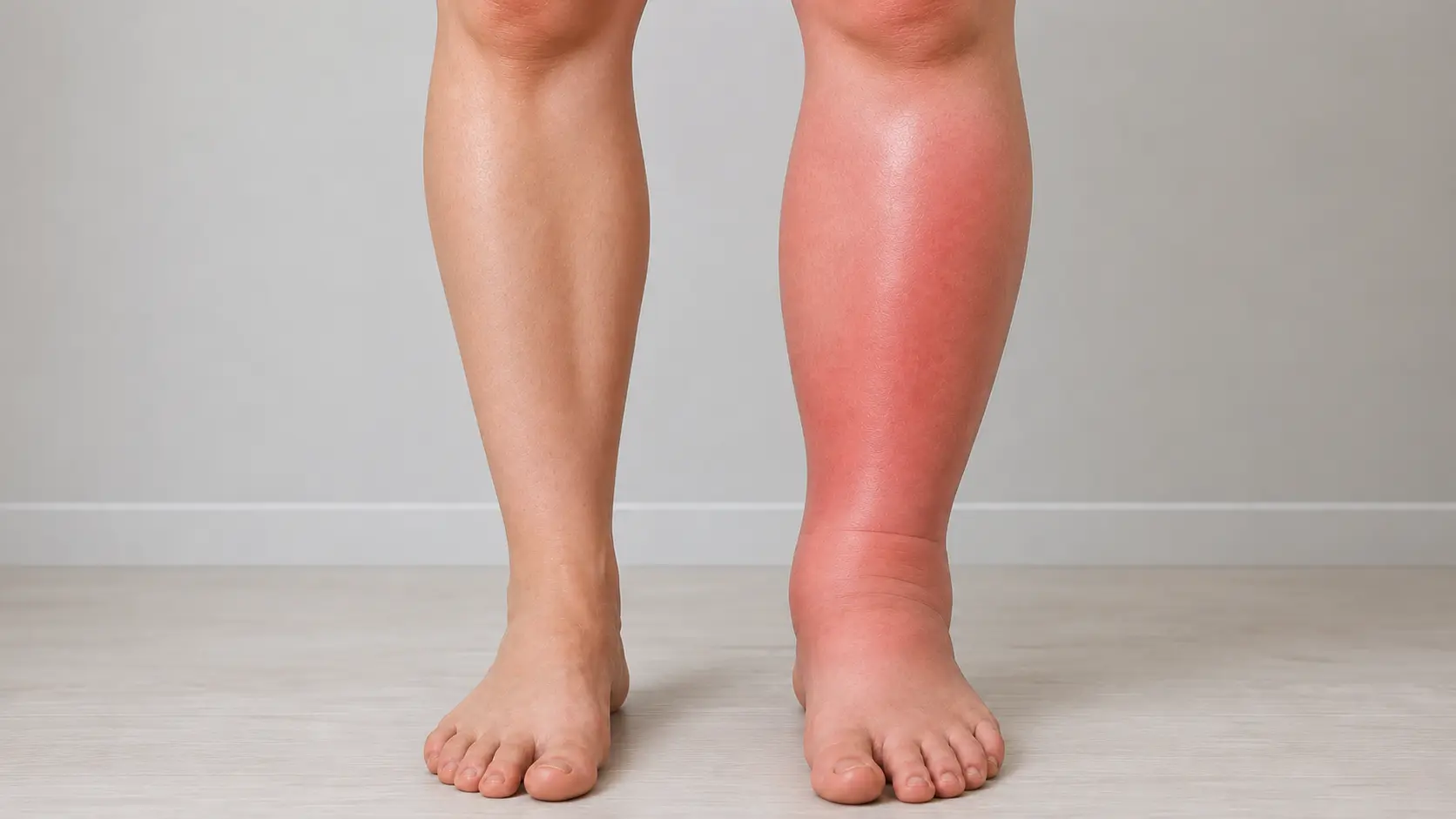
Folliculitis, small pimple like bumps at the recipient sites, can appear while the scalp heals. Temporary shedding of both transplanted and natural hair, known as shock loss, is common and resolves on its own. FUE also leaves small white dot scars across the donor area, so it is not truly scarless, and what those scars actually look like is worth understanding honestly before surgery rather than after.
Benefits of FUE
- No linear scar, so most patients can wear their hair very short.
- Faster recovery than FUT, often back to normal in days, not weeks.
- Natural, permanent results once the graft takes root, with survival rates reported as high as 98% in skilled hands.
- Works beyond the scalp too, including eyebrows, beard, and other areas.
- Many patients report a real gain in confidence once visible coverage grows back.
Summary
FUE hair transplant moves individual hair follicles from a dense donor area to a thinning or bald area using a small punch tool, avoiding the linear scar left by older strip methods. The procedure costs between $4,000 and $15,000 per session in the USA, with price shaped by graft count, surgeon experience, and location. Recovery is fairly quick, with visible growth starting around month 3 to 4 and full results settling in over 6 to 12 months. The technique can treat the scalp, eyebrows, beard, and select body areas, and it carries real but manageable risks. Outcomes depend heavily on choosing a qualified, experienced surgeon rather than the cheapest available option.
FAQs
How long will a FUE hair transplant last?
Transplanted hair is usually permanent because it comes from a donor area that resists the hormone linked to pattern baldness. The surrounding natural hair can still thin over time, which is why some patients choose a touch up session years later.
What is better, FUE or FUT?
There is no single better technique for every patient. FUE avoids a linear scar and suits patients who want shorter hairstyles, while FUT often costs less per graft and can move more hair in a single session. The right choice depends on the patient’s goals, donor supply, and budget.
How much does a FUE transplant cost?
Most sessions in the USA cost between $4,000 and $15,000. Larger or multi session cases can cost $50,000 or more, depending on graft count and surgeon fees.
References
- International Society of Hair Restoration Surgery. Guide to FUE Hair Transplant: Benefits, Process and Recovery.
- Sharma R, Ranjan A. Follicular Unit Extraction (FUE) Hair Transplant: Curves Ahead. Journal of Maxillofacial and Oral Surgery, 2019.
- Cleveland Clinic. Hair Replacement Surgery.
Disclaimer: This article is based on peer reviewed medical literature and hair restoration medical sources, offering a technically accurate look at FUT hair transplant surgery for general informational purposes only. It is not a substitute for professional medical advice.

While sorting clothes for autumn, I noticed that warm colours make me look tired, while smoky blue, soft grey, and muted berry feel easier to wear. That made me wonder whether my hair colour creates the same issue. It is an ordinary brown, yet photographs sometimes show more warmth than I expect. I am not trying to label myself perfectly or rebuild my wardrobe around a trend. I only want a softer overall look. I used [url=https://hair-expert.top]this colour comparison page[/url] beside a few scarves I already own. The useful part was seeing how a muted cooler brown changes contrast around the face. Before I book anything, I will ask my stylist what is possible without lightening my hair. A gloss or low-commitment toner seems especially practical. I would genuinely value advice from people who has carefully made one gentle change and then lived with it in natural daylight for some weeks. Did you start with hair, clothes, or makeup? Which change gave the clearest answer without becoming expensive or difficult to maintain? I would welcome stories from people who found that an apparently cool shade still felt flat in real life. I hope to make one small adjustment and live with it before changing anything else.
Viajare con mi familia a Tenerife y valoramos una actividad en moto de agua para una tarde libre. Mis hijos adolescentes tienen una confianza distinta en el mar. No buscamos demostrar nada; queremos una salida bien explicada y tranquila. Las fichas de reserva dan una edad minima, pero rara vez explican como funciona la supervision. Para preparar preguntas consulte [url=https://motoacuaticatenerife.top]esta guia de motos de agua en Tenerife[/url]. Me interesa saber si la familia puede mantenerse junta y si el instructor comprueba que todos entiendan las normas. La explicacion debe ser breve. El instructor ha de ser atento. La distancia entre motos debe ser prudente. El agua deberia estar segura. El chaleco tiene que ser limpio. El grupo debe avanzar a un ritmo agradable. El muelle deberia resultar ordenado. El horario ha de ser claro. La espera debe ser razonable. La reserva tiene que quedar simple. La informacion final deberia ser amable. La experiencia debe parecer segura. El ambiente deberia ser tranquilo. ?Conviene reservar por la manana con adolescentes? ?Que pregunta evito una sorpresa en el muelle? Quedo atento a detalles utiles.
I am editing a remote podcast interview for a local history group. The conversation is clear and worth keeping, but a few transitions contain tiny digital ticks and a light shimmer around some consonants. Because the guest speaks quietly, I do not want aggressive processing to make the voice sound flat or distant. I have been reading about different ways to inspect a recording and came across [url=https://sunoaudiofix.top]a neutral cleanup overview[/url]. I am not looking for a one-click promise; I need a sensible review process before I touch the final edit. Would you begin with visual inspection, careful listening, or short comparison exports? The interviewee’s voice needs to stay recognizable. Each small repair should be easy to undo. I can work on a few troublesome moments at a time. The dialogue must remain clear. I would prefer modest adjustments over broad filtering. A separate comparison export would help with judgment. I also need clear notes for the producer. The room tone should remain stable. The final episode must still sound direct. Each decision should remain safe to explain. I can review it at normal volume. I can accept a trace of noise if the words remain easy to follow. What has worked well when a spoken recording needs restrained repair? Thanks for describing your process.
Hola a todos, estoy preparando un viaje a Tenerife y me encantaria hacer jetski durante mi estancia. Estuve buscando informacion sobre los dos lugares mas conocidos para esta actividad: Los Gigantes y Playa de las Americas. Por lo que he visto, Los Gigantes tiene unos acantilados majestuosos que creo que ofrecerian unas vistas preciosas mientras estas sobre el agua, pero he leido que puede ser un poco mas dificil para alguien con nivel intermedio, especialmente con el oleaje y las corrientes que pueden ser un desafio. Por otro lado, Playa de las Americas resulta mas adecuada para niveles intermedios, ideal para disfrutar sin tanto estres, aunque las vistas no son tan impresionantes. Para alguien que aprecia tanto el entorno como la comodidad del recorrido, ?cual recomendarian? He encontrado un post con fotos y contenido visual que aclara bastante la eleccion [url=https://alquilermotoacuaticatenerife.top]moto de agua los cristianos[/url] , pero estaria genial leer vivencias personales de quienes hayan probado jetski en ambos sitios. ?Cual creen que tiene mejores condiciones para alguien como yo que busca un reto moderado y un entorno bonito? Gracias por tomarse el tiempo de responder.
I am planning a capsule wardrobe and want to confirm my season before choosing the main colors. Repeated questionnaires place me near autumn although the exact subtype changes. Earthy taupe and olive are reliable but mustard and strong rust can make my complexion look uneven. Since I want a streamlined wardrobe each neutral and accent needs to combine easily with the others. [url=https://seasonal-palette.top]autumn seasonal palette[/url] helps me group the likely shades but I would like to validate the direction with actual fabric. I thought about starting with cream, warm navy, chocolate, olive, muted teal, and brick. I can take consistent pictures in indirect daylight using the same camera settings. When evaluating base colors should I focus more on skin clarity or on harmony with my hair and eyes? I also need two accents that can work across casual and slightly formal outfits. Soft petrol blue looks encouraging while brick red may be easier than orange. Is this range useful for checking autumn or should I add a cooler control color for comparison? A short practical test list would help me avoid buying colors based only on a label. My focus is a wearable result rather than following every suggested autumn shade. Thanks for any practical advice
I am trying to choose between Soft Winter and Deep Winter before replacing a few wardrobe basics. Many quick seasonal guides make both directions seem reasonable when I look at them separately. Because my overall contrast is not obvious, I do not want to assume that the deepest colours are automatically best. In neutral morning light some berry shades look clear while others make my face seem flatter. I have started checking charcoal, navy, and softer grey fabrics rather than relying on one dramatic colour. One useful suggestion was plain photos and the same lighting so that the comparison stays fair. I plan to keep the time of day consistent for each comparison. For the first pass, I am referring to [url=https://faceshapeanalysis.top]color analysis[/url] That should help me narrow the list before I buy anything. How do you separate these two palettes when neither result feels completely clear?
I have been trying to understand my color season, but the outcome keeps moving between two neighboring palettes. One tool places me in Soft Summer while another leans toward Soft Autumn. My skin reads as broadly neutral and both muted ranges seem plausible in indoor light. I reviewed multiple natural-light pictures but camera settings may be influencing what I see. Before spending money on new pieces I would like a more repeatable way to compare the options. [url=https://seasonal-palette.top]seasonal palette test[/url] looks like a useful checklist rather than a final verdict. Would you treat undertone as the first clue or compare chroma and contrast before temperature? I can borrow fabric swatches so I am happy to do a careful home check. A bright window gives neutral light and I can keep the camera exposure fixed. What evidence would make you confident that one muted season is more accurate than the other? I am looking for repeatable comparisons from people who have worked through a similar overlap. One final concern is avoiding changes caused only by camera white balance. It would also help to learn how many comparisons are usually enough before a pattern becomes clear. Any experience would be welcome
Our small listening club compares unusual generated tracks once a month, and one recent piece raised a useful question about visual analysis. The track has an appealingly strange shimmer while others found a narrow ringing tone tiring The group agrees that ears come before a visual tool But an image could help us locate the suspected moment My preference is to write impressions before opening any analyzer Then we could check whether the reported timestamps point to the same area The approach could prevent us from confusing novelty with a defect [url=https://fixesuno.top]spectrogram generator[/url] may help us compare observations without pretending it supplies the answer We would keep the screenshots and timestamps beside the written notes How do experienced listeners combine visual clues with relaxed listening? I am interested in methods that remain curious and modest, leaving room for disagreement, surprise, and ordinary musical enjoyment.
I’m reducing my wardrobe and would like a small group of colors that works with the clothes I already wear. I keep finding similar tops that work differently with the same jacket. I don’t need a perfect seasonal label, but I would like to understand why some combinations look calmer than others. My first thought is to pick two neutrals and one accent. Before removing anything, I want to try each top near my face in the same daylight and take notes. The final colors need to work with the outer layer I use regularly. I found a guide on [url=https://hair-color.top]find my color palette[/url] while looking for a sensible way to organize that test. Would you start with the most flattering top or the most useful jacket? I want to avoid keeping colors just because a chart says they belong to my season. If you’ve done this, how many colors proved useful day to day? I can lay the candidates out together before deciding. Then I can judge the colors in the context of my wardrobe. I’m interested in a process that helps me use what I own before buying anything new. I’d welcome a simple way to record the results.
I am in a small theatre production next month, and the costume designer suggested face-framing bangs for my character. That sounds lovely in a still photo, but I have to pin my hair up between scenes, sometimes in less than two minutes. I spend a fair amount of the show moving rather than standing still. A fringe that falls into my eyes would be distracting, particularly with bright lights facing the audience. I need to see my marks clearly through each scene. My hair is fairly fine with only a slight wave, so I cannot count on a styled bend staying in place for the whole performance. I found [url=https://hairstylingtips.top]curtain bang lengths[/url] helpful for naming the options, but I need to decide where the shortest pieces should actually end. Would a longer fringe be easier to pin back quickly? I can rehearse with clips before cutting anything, although the final costume headpiece may change how the hair sits. I can practice the change during a full rehearsal. I need something I can wear comfortably outside the production. I need a shape that survives the show, not just the initial styling. Has anyone dealt with bangs during quick costume changes? What length gave you a useful frame without blocking your view?
I am in a small theatre production next month, and the costume designer suggested face-framing bangs for my character. I like the shape in the costume sketch, but I have to pin my hair up between scenes, sometimes in less than two minutes. I spend a fair amount of the show moving rather than standing still. A fringe that falls into my eyes would be distracting, particularly with bright lights facing the audience. I need to see my marks clearly through each scene. My hair is fairly fine with only a slight wave, so I cannot count on a styled bend staying in place for the whole performance. I found [url=https://hairstylingtips.top]curtain bang lengths[/url] helpful for naming the options, but I need to decide where the shortest pieces should actually end. Would cheekbone-length pieces still tuck behind an ear? I can rehearse with clips before cutting anything, although the final costume headpiece may change how the hair sits. There is time to test the pins before opening night. The fringe should still be manageable on ordinary days. A workable backstage routine matters more to me than a perfect publicity photo. Has anyone dealt with bangs during quick costume changes? What length gave you a useful frame without blocking your view?
I am growing out my natural gray after many years of coloring and the changing contrast is making some dependable clothes look unfamiliar near my face. I want to observe the transition patiently while continuing to use most of what I own. Deep denim is still easy to wear, but a few warm beige and brown tops now seem disconnected from the cooler hair around my temples. I do not want to replace everything during the transition, especially because the dyed lengths will remain for quite a while. I found this [url=https://onlinehaircolor.top]personal color analysis[/url] as a simple log while my overall contrast changes. Would repeating three test colors be more useful than a full palette, and should I then wait until more natural hair has grown before changing larger pieces? Small items could adjust the colors nearest my face. Please share a gradual approach that avoids chasing every intermediate stage.
I recently stopped covering my gray hair and the changing contrast is making some dependable clothes look unfamiliar near my face. I want to observe the transition patiently while continuing to use most of what I own. My dark navy jackets remain useful, but a few warm beige and brown tops now seem disconnected from the cooler hair around my temples. I am trying not to make permanent purchases from a changing appearance, especially because the dyed lengths will remain for quite a while. I am referring to this [url=https://onlinehaircolor.top]personal color analysis[/url] as a simple log while my overall contrast changes. Could I start with scarves in two neutrals and one accent, and should I then wait until more natural hair has grown before changing larger pieces? Small items could adjust the colors nearest my face. Which changes are worth making early, and which should wait?
I need new glasses and am deciding between warm tortoiseshell and dark blue frames. A seasonal quiz gave me an Autumn result, but I am unsure which frame looks better beside my face. The shop lighting is warm, and both options look different outside. As I use glasses all day, I want a choice that feels comfortable with ordinary clothes as well as with my skin tone. I have tried each frame with a cream top and a cool gray top, but that also changes the background against which I judge them. My current idea is to take a short video in indirect daylight while keeping the camera exposure fixed. I could also ask a friend to look at the frames in person, since a phone image may exaggerate the warmth of the store lights. When I searched for ways to compare colors, I found a page about [url=https://findhairstyle.top]what is my color palette[/url] as a starting point, but I would like a method that works for this purchase, even if my season label remains uncertain. Would you ask to see both frames outside first, or would you focus on how they balance the color of the eyebrows and eyes? I can return to the shop in daylight. I want to compare them properly. Any practical frame comparison would help. Photos might help me remember the difference.
I have a hair appointment soon and want to settle a palette question before choosing a shade. One quiz put me in Deep Winter; another suggested Deep Summer. The difference seems small on screen but noticeable when I hold clothes beside my face. In daylight, black looks fairly strong on me, yet some cool muted colors also seem comfortable. I do not want to treat a camera result as a final answer because the room lighting and automatic white balance change the appearance of my skin. I have started comparing a few pieces I already own rather than buying a full new wardrobe. I am looking at whether clear jewel tones or softer cool shades make my eyes look more defined, and whether either group emphasizes shadows under them. When I talk to the stylist, I would like to bring a few specific color references instead of just naming a season. I found a page about [url=https://findhairstyle.top]color analysis[/url] while sorting out the terms, but I would value observations from people who have compared these two palettes in person. Would you test fabric near the face first, or is there another simple check that helped you decide? A temporary shade is also an option for me. Practical checks would be very helpful. I will also ask the stylist to show a few swatches. Thanks for any advice from your own experience.
I am trying to make my wardrobe smaller, and I would rather understand which colors I actually wear well before buying anything new. I started with the clothes I already own. The same blue looks calm next to my face by a window, but oddly harsh under the warm bulbs in my room. That makes my first impression unreliable. I have been reading about [url=https://body-shape.top]personal color analysis[/url] as a way to give these comparisons some structure. I would hold each sample at the same distance. I can do a careful comparison in daylight this weekend. I would place a few fabrics near my face, keep the background neutral, and take notes instead of trusting a single photo. Would you start with muted and bright versions? I could note the effects before looking at photographs. I am also unsure whether to include makeup, since it might change the result I am trying to observe. A simple repeatable sequence would help me. If you have tested colors this way, what did you look for in your face and eyes, and which differences were too subtle to trust? I would rather learn from my existing clothes first. Any practical order for the comparisons would be appreciated.
I am trying to make my wardrobe smaller, and I would rather understand which colors I actually wear well before buying anything new. I laid out several pieces I wear regularly. The same blue looks calm next to my face by a window, but oddly harsh under the warm bulbs in my room. That makes my first impression unreliable. I have been reading about [url=https://body-shape.top]personal color analysis[/url] as a way to give these comparisons some structure. I would hold each sample at the same distance. I can do a careful comparison in daylight this weekend. I would place a few fabrics near my face, keep the background neutral, and take notes instead of trusting a single photo. Would you compare light and dark versions first? I could write down what changes with each fabric. I am also unsure whether to include makeup, since it might change the result I am trying to observe. I am looking for a process rather than a label alone. If you have tested colors this way, what did you look for in your face and eyes, and which differences were too subtle to trust? I want to keep the pieces that work, not replace everything. Any practical order for the comparisons would be appreciated.
I am putting together a smaller work wardrobe after a change in size, and I keep mixing up two separate decisions: whether a garment fits well and whether its color works near my face. I can judge the fit in a mirror. Color feels less obvious under store lighting. A charcoal jacket seems useful, yet several shirts I already own make my skin look dull when I wear them with it. I want to make the clothes I own work before buying more pieces. I have been reading about [url=https://bodyshapecalculator.top]color analysis[/url] and comparing those notes with ordinary fit advice, but I still need a simple test I can repeat at home. Would you test two existing tops in natural light and photograph them against the same neutral background? The hardest comparison for me is navy against charcoal because both seem sensible on a hanger. I also wonder whether a warmer cream shirt would be more helpful than stark white. If you have narrowed a wardrobe this way, which observations actually helped you choose repeatable colors rather than just picking the outfit that looked best in one photo? I would value a simple checklist so I can keep fit and color decisions separate while I make a short shopping list.
I am rebuilding a small work wardrobe after a change in size, and I keep mixing up two separate decisions: whether a garment fits well and whether its color works near my face. The fit is fairly easy to check in a mirror. Color feels less obvious under store lighting. A charcoal jacket seems useful, yet several shirts I already own make my skin look dull when I wear them with it. I would rather use what I have before buying more pieces. I have been reading about [url=https://bodyshapecalculator.top]color analysis[/url] and comparing those notes with ordinary fit advice, but I still need a simple test I can repeat at home. Would you test two existing tops in natural light and photograph them against the same neutral background? Navy and charcoal are the pair I cannot settle because both seem sensible on a hanger. I also wonder whether a warmer cream shirt would be more helpful than stark white. If you have narrowed a wardrobe this way, which observations actually helped you choose repeatable colors rather than just picking the outfit that looked best in one photo? A practical sequence would help so I can keep fit and color decisions separate while I make a short shopping list.
I have several video presentations coming up and want to select a small rotation of clothes for the camera. The mirror and the video preview give me different impressions, especially when a shirt contrasts strongly with my pale background. I am not trying to look formally dressed every day; I mainly want my face to remain easy to see. Keeping the room setup unchanged should let me compare several solid-colored tops without confusing clothing differences with lighting changes. I found a page about [url=https://outfit-style.top]color analysis[/url] and would like to use the idea as a starting point for these comparisons. I have ruled out narrow stripes for now, since the preview makes them distracting despite an otherwise comfortable fit. Would you judge the colors from a short recording rather than the live preview, or is either method equally useful? I also wonder whether a good color beside my face needs to coordinate closely with the background of the room. I would welcome a simple comparison routine, particularly one that does not assume a single color works for every person.
I am sorting my wardrobe before moving, and the number of almost identical tops has become a problem. The difficulty is that each piece looks reasonable alone, yet several colors seem awkward beside my usual trousers. A compact wardrobe appeals to me, provided it allows a few different combinations instead of one repeated outfit. My first step has been comparing clothes I already own, especially combinations that can work without another purchase. I found a page about [url=https://outfit-style.top]color analysis[/url] and would like to use the idea as a starting point for these comparisons. Dark blue is easy for me to combine, but I am less certain about cream, rust, and muted pink. Should I settle on a pair of practical neutrals before testing accents, or approach the decision in reverse? Another question is how to tell whether a disappointing outfit comes from its color or from the garment shape. If you have reduced your wardrobe successfully, which comparison helped you decide what deserved space in the final selection?
Выбираю билеты на поезд после прилёта в Сочи и стараюсь понять, какой интервал между ними будет разумным. Еду с обычным чемоданом, без желания бежать по переходам и искать нужную платформу в последнюю минуту. В разных советах пишут просто про вокзал, хотя для расчёта дороги мне необходимо его точное название. При поиске схемы пересадки нашёл тему [url=https://travelgid.top]сочи аэропорт и жд вокзал расстояние[/url] — это отправная точка для дальнейших уточнений. Ещё хочу заранее сохранить схему переходов в телефоне, чтобы не искать её после прилёта. Если потребуется пересадка по пути, важно понимать, где покупать следующий билет и как ориентироваться с чемоданом. Но расстояние само по себе ещё не объясняет, сколько займёт дорога после получения багажа и выхода из терминала. Подскажите, какой запас вы обычно оставляете, если оба билета куплены отдельно и следующий поезд пропускать нельзя. Точные расписания проверю перед покупкой, сейчас хочу понять порядок действий и возможные места, где теряется время. Если поделитесь опытом, напишите точное название вокзала и были ли у вас чемоданы: это поможет сравнить условия.
Собираюсь съездить из Берлина в Потсдам на день и пытаюсь составить маршрут, который не потребует постоянной спешки. Начать поездку могу только после завтрака, и задерживаться до позднего вечера у меня не получится. Мне нужен спокойный порядок действий: добраться, погулять и вернуться, оставив небольшой запас на непредвиденные задержки. Для подготовки нашёл материал по запросу [url=https://travelgid.top]потсдам сан-суси как добраться[/url] — это отправная точка для дальнейших уточнений. С собой планирую взять воду и небольшой перекус, но остановку на обед тоже хотелось бы предусмотреть. Для меня это первая поездка в Потсдам, поэтому расстояния по карте пока трудно соотнести с реальной прогулкой. Теперь хочу уточнить у тех, кто ездил самостоятельно: от какой точки удобнее начинать пешую часть маршрута? Особенно интересует, стоит ли сначала идти в парк или оставить его после короткой прогулки по центру. Заходить во все дворцы не планирую, потому что важнее спокойно пройтись и не следить постоянно за часами. Если мой план переоценивает доступное время, помогите выбрать, от чего отказаться, чтобы поездка осталась приятной.
Выбираем место для семейного отпуска, в котором пляж будет удобен маленькому ребёнку. Красивые фотографии помогают составить список, но по ним сложно понять, как проходит обычный день у воды. Главный критерий для нас — возможность спокойно подойти к воде. Ещё ищем место, где можно укрыться от солнца. Не хотим каждый раз собирать все вещи и долго идти обратно к жилью, когда ребёнок устанет. Бытовые вопросы вроде туалета и питьевой воды тоже включили в список. Для первоначального поиска смотрим материалы по теме [url=https://spainbeaches.top]канарские острова[/url] и дальше сопоставляем выбранные места по удобству для семьи. Аренду машины на весь срок ещё не решили. Поэтому длинный путь от остановки или крутой спуск могут оказаться важнее живописного вида. Ещё хочется понять, будет ли удобно идти к пляжу с коляской и сумкой для детских вещей. На что ещё смотреть, прежде чем оплачивать проживание рядом? Буду благодарен за примеры с описанием подхода к воде и ближайшей инфраструктуры.
На этот раз выбираю побережье с более прохладной погодой и рассматриваю север Испании. Думаю о поездке, в которой можно чередовать прогулки у моря, небольшие города и спокойные дни без плотной программы. Плавать каждый день необязательно, но иногда зайти в воду всё же хочется. Пока трудно выбрать между открытым побережьем и более защищёнными бухтами. На фотографиях оба варианта выглядят привлекательно, а вот ощущения при ветре и пасмурной погоде представить сложнее. Для выбора района сначала изучаю соседние населённые пункты. В частности, рассматриваю [url=https://spainbeaches.top]города на севере испании[/url] и отмечаю интересные места на случай неподходящей для пляжа погоды. Не стремлюсь объехать всё побережье за одну поездку. Скорее проведу больше времени в одном месте, чем буду спешить дальше. Отдельно рассматриваю доступность магазинов и кафе, чтобы в дождливый день не зависеть от длительной поездки в другой город. Что посоветуете учитывать при таком сочетании моря и пеших прогулок? Интересуют личные наблюдения о ветре, подходах к берегу и жизни небольших курортов.
Навожу порядок в семейном списке ссылок после переноса заметок. За несколько поездок накопились страницы, скриншоты и короткие подписи, смысл которых уже не всегда понятен. Некоторые материалы сохраняли для реального выезда, другие просто казались интересными. Хочу оставить небольшой список с понятными пояснениями. Полностью очистить список не хочется, хотя пользоваться им трудно. Среди неподписанных записей нашлась ссылка с пометкой [url=https://wiengid.top]venagid[/url] — думаю отмечать рядом, зачем мы сохранили конкретную страницу. Не собираюсь считать старую закладку готовой инструкцией. Если снова понадобится соответствующая тема, проверим условия заново и зафиксируем дату этой проверки. Мне кажется удобной схема из темы, источника и вопроса. Дополнительно поставлю дату, когда запись действительно просмотрели. То, что ещё требует проверки, отметим прямо в записи. Список общий, и им пользуются несколько человек, поэтому подпись должна быть понятной без объяснения автора. Хочется открывать заметку и сразу видеть, что осталось выяснить перед поездкой. Как вы отличаете полезный источник от случайной ссылки, когда возвращаетесь к заметкам через год? Покажите удобный пример подписи без личных данных.
Wahrend einer Stadtereise nach Barcelona bleibt uns ein ganzer Tag fur Meer und Strand. Wir wohnen im Zentrum und sind ohne Auto unterwegs. Lange Umstiege passen nicht zu einem entspannten Badetag. Wir planen keinen kurzen Fotostopp, sondern mehrere Stunden am Meer. Ein etwas ruhigerer Abschnitt ware uns lieber als die vollste Promenade. Der Ruckweg soll auch am fruhen Abend mit dem Nahverkehr moglich sein. Wir nehmen nur leichtes Gepack und keine gro?en Strandmobel mit. Ein kurzer Spaziergang vom Halt zum Strand ware vollig in Ordnung. Bei sommerlichen Temperaturen sollen die Laufstrecken nicht ausufern. Bei der Recherche habe ich [url=https://inselhuepfen.top]barcelona beste strande[/url] notiert. Welche Abschnitte wurdet ihr fur diesen Tagesplan vergleichen? Besonders hilfreich waren Erfahrungen zur tatsachlichen Fahrzeit, zur Orientierung vor Ort und zur Ruckfahrt am Abend. Auch Hinweise zu Schatten und einfachen Pausenmoglichkeiten wurden uns bei der Wahl helfen. Wir mochten die Entscheidung vorher treffen, damit wir den Tag nicht mit mehreren spontanen Ortswechseln verbringen.
Fur eine knappe Woche in Andalusien uberlegen wir, welche Orte am Meer sich ohne Mietwagen gut kombinieren lassen. Wir reisen zu zweit und mochten nicht jeden zweiten Tag die Unterkunft wechseln. Wir wurden gern auch abends zu Fu? durch eine Altstadt gehen. Bei den Ortswechseln mochten wir uns vor allem auf Zuge stutzen. Fur die letzte Etappe kommt auch ein Bus infrage. Zu viele Umstiege wurden uns dagegen Zeit vom Urlaub nehmen. Pro Station planen wir lieber mehrere Ubernachtungen ein. Der Strand muss nicht direkt an der Unterkunft beginnen. Entfernungen auf der Karte sagen wenig uber angenehme Fu?wege aus. Bei der Suche habe ich [url=https://inselhuepfen.top]andalusien schone orte am meer[/url] notiert. Welche zwei Orte wurdet ihr unter diesen Bedingungen auswahlen? Uns helfen Erfahrungen zu Bahnhofen, Wegen in die Altstadt und dem Zugang zum Strand mehr als eine lange Liste von Sehenswurdigkeiten. Auch Hinweise zu Gepack und zur Lage geeigneter Unterkunfte waren hilfreich. Wir mochten genug freie Zeit fur beide Orte behalten und die Reise nicht durch standiges Packen zerlegen.
Для встречи разговорного клуба выбираю тему самостоятельных путешествий. Мы не продаём экскурсии и не составляем настоящий маршрут. Задача проще: научиться задавать уточняющие вопросы, когда читаешь чужое описание путешествия. Ищу компактный пример, который удобно обсуждать вместе. Предлагаю разбиться на пары и сопоставить получившиеся вопросы. В поисковой подборке встретилось сочетание [url=https://wiengid.top]михаил шварц путешествия[/url] — ссылку пока рассматриваю только как возможный материал занятия. Прежде чем что-либо раздавать, выберу небольшой фрагмент и проверю, подходит ли он нашей группе. Хотелось бы отделить личные впечатления автора от сведений, которые читатель должен уточнить самостоятельно. Одна пара могла бы выписать вопросы о дороге. Другая проверит, понятно ли описан порядок действий. Также отметим места, которым нужна дата или пояснение. Уровень подготовки у всех разный, поэтому важно, чтобы участник мог объяснить свой вопрос обычными словами и показать, какой фрагмент текста заставил его об этом задуматься. Какое задание помогает новичкам читать такие материалы внимательно, но не превращает встречу в экзамен? Поделитесь примером упражнения минут на десять.
Fur einen kurzen Zwischenstopp in Madrid suche ich eine Route, die sich an einem Tag gut zu Fu? schaffen lasst. Mein Zug kommt am Morgen an, am Abend geht es schon weiter. Deshalb mochte ich nicht standig quer durch die Stadt fahren oder mit langen Warteschlangen rechnen. Fur den Start wurde ich am liebsten einen Ort wahlen, den ich vom Bahnhof leicht erreiche. Mich interessieren vor allem Stra?en, Platze und Cafes, an denen man auch einfach eine Weile sitzen kann. Auf meiner Liste stehen die Gegend um die Puerta del Sol, der Plaza Mayor und vielleicht der Retiro. Bei einem Museum bin ich noch unsicher, weil dafur schnell mehrere Stunden vergehen. Zwischen den bekannten Orten entdecke ich gern auch eine ruhigere Stra?e. Ware es sinnvoll, zuerst durch die Altstadt zu laufen und den Park fur den Nachmittag aufzuheben? Bei der Vorbereitung habe ich nach [url=https://inselurlaub.top]1 tag in madrid[/url] gesucht. Solche Ubersichten helfen mir, Entfernungen einzuschatzen, ersetzen aber keine Erfahrungen mit dem tatsachlichen Tempo vor Ort. Auch eine Mittagspause mochte ich fest einplanen; ein voller Zeitplan ware fur mich wenig hilfreich. Falls jemand diese Strecke kurzlich gegangen ist: Wo wurdet ihr einen Abstecher streichen, wenn es unterwegs spater wird? Mich interessieren besonders Wege, die ohne Reservierung und ohne Auto funktionieren. Falls das Wetter umschlagt, ware eine leicht anpassbare Route praktisch. Uber einen konkreten Vorschlag fur den Vormittag und den Nachmittag wurde ich mich freuen.
I have a salon appointment coming up, and I am trying to narrow down a hair color before I get there. I recently started reading about [url=https://choosehairstyle.top]color analysis[/url] because the tones I like in photos do not always look the same next to my face. I have not colored it in years, so I am wary of a sudden jump. I may fit a cooler palette, but I would rather check that impression against real hair samples. My natural hair is medium brown, and I want a change that is noticeable without committing to constant upkeep. Photos of muted brown and darker blonde appeal to me, but salon lighting may be doing much of the work. I also know that a dye swatch can look different against skin, eyebrows, and the color already in the hair. Is it more useful to hold actual swatches beside the face than to rely on a season name? I can bring daylight photos and explain my maintenance budget. That seems more useful than asking for an exact shade number from a quiz. A strand test might show how the color takes on my actual hair. If you have made a similar change, which small details helped you avoid a color that looked too flat or too harsh? Examples from people who started with medium brown hair would help me compare options.
En una ruta por Andalucia nos planteamos dormir cerca de Ronda en una burbuja. Nos apetece cambiar una noche de hotel convencional, pero viajariamos en verano y no sabemos cuanto se calienta antes de que caiga el sol. Preferimos una temperatura estable. Por eso quisiera saber si la climatizacion funciona toda la noche sin hacer ruido. Tambien me pregunto como se resuelve la ventilacion al amanecer. He encontrado informacion general sobre [url=https://dormirenunaburbuja.top]casa burbujas ronda[/url] pero antes de elegir una fecha quiero preguntar por las condiciones concretas de cada establecimiento. ?Hay alguien que haya probado este tipo de alojamiento en pleno verano? Iremos con equipaje ligero. Queremos pasear por Ronda y llegar despues; importa la hora limite de entrada y si el camino esta indicado. Entendemos que la meteorologia puede cambiar y no esperamos una vista perfecta. Si queremos saber que sucede si hay tormenta o viento fuerte y si las condiciones de cambio de fecha aparecen por escrito antes del pago. Tambien preguntaria por la limpieza del material transparente y por la separacion entre habitaciones. Si habeis estado en una burbuja por esa zona, ?que detalle os hizo decidir que la reserva merecia la pena? Cualquier dato sobre temperatura, llegada o cambios de fecha sera bienvenido.
Nachsten Monat bin ich einen Tag allein in Alicante und plane einen entspannten Weg vom Zentrum zum Meer. Meine Unterkunft liegt beim Bahnhof. Morgens mochte ich durch die Altstadt gehen, spater am Wasser sitzen und zwischendurch etwas essen. Den Vormittag mochte ich fur die Gassen und Platze im Zentrum nutzen. Ich wurde Santa Cruz gern sehen, mochte den Anstieg aber lieber zu einer passenden Tageszeit machen. Bei der Suche nach [url=https://inselurlaub.top]alicante santa cruz[/url] habe ich ein paar Karten und Beschreibungen gefunden. Vor Ort ist die Frage fur mich eher, wie man die Wege sinnvoll legt und wo man unterwegs eine Pause einlegt. Welche Route vom Bahnhof durch Santa Cruz bis ans Meer wurdet ihr empfehlen? Ein langer Strandtag ist nicht geplant; eine Stunde am Wasser wurde mir reichen. Das Castillo ware nur dann eine Option, wenn der Weg und die Temperaturen noch passen. Bei gro?er Hitze bleibe ich lieber unten und genie?e den Blick aufs Meer. Mir ist wichtig, dass der Rundgang auch mit einer langeren Kaffeepause entspannt bleibt. Falls ihr Alicante ohne Auto besucht habt: Wo habt ihr mittags pausiert, und welcher Abschnitt war zu Fu? besonders lohnend? Hinweise zu Schatten und Steigungen waren hilfreich. Falls es am Nachmittag zu hei? wird, mochte ich den letzten Abschnitt flexibel halten. Danke fur Vorschlage, die ohne straffen Zeitplan funktionieren.
I have been comparing phone photos because I want a better starting point for choosing a hair shade. The same face looks warmer by a window in the evening and cooler under a bright bathroom light. That makes the result feel less certain than the tidy labels on the screen suggest. I am starting with light brown hair and only want a modest shift in tone. I found [url=https://choosehairstyle.top]skin tone analysis[/url] while looking for a way to compare images, but I still need a sensible way to use the information. My goal is a hair color that looks comfortable in ordinary daylight, not one that only works in a filtered photo. I can take pictures with the same plain background, no beauty filter, and my hair pulled away from my face. Would indirect daylight and a neutral shirt make comparisons more consistent? I am also thinking of holding a few fabric colors near my face rather than deciding from a single photograph. I could ask the stylist to check physical swatches beside my face and existing hair. That would give us something concrete to discuss instead of trying to prove that an app assigned the right season. I plan to compare the samples without editing the pictures afterward. What practical check helped you when photos pointed toward different undertones?
Estoy preparando una escapada de dos noches a Granada porque me gustaria fotografiar el cielo y, al mismo tiempo, dormir en un sitio tranquilo. La experiencia de dormir bajo las estrellas me llama la atencion, pero las fotos de las fichas no siempre explican lo que se ve realmente desde la cama. Prefiero una zona con poca iluminacion exterior a una habitacion con muchos accesorios. La estancia duraria dos noches como maximo. Tambien me preocupa que el plastico se empane o que la temperatura cambie mucho durante la noche. ?Que tal resulta pasar la noche alli cuando refresca despues de cenar? He visto esta pagina sobre [url=https://dormirenunaburbuja.top]hotel burbuja granada[/url] y la estoy usando para ordenar opciones antes de preguntar a cada alojamiento por separado. Pienso consultar la prevision antes de salir. Me vendria bien saber si la zona de observacion queda cerca de otras habitaciones. Otro detalle es la llegada: llevare tripode y una bolsa de equipo, asi que agradeceria saber si el acceso desde el aparcamiento es sencillo. No necesito una recomendacion de lujo, sino informacion concreta sobre el lugar. Si alguien conoce un alojamiento de la zona, ?preguntariais primero por orientacion, calefaccion o normas para salir a hacer fotos de madrugada? Con un par de detalles reales podre elegir con mas criterio. Gracias por compartir lo que os resulto comodo y lo que revisariais antes de repetir.
I am looking for a first levada walk in Madeira, but route length alone does not tell me whether it will be comfortable. I can manage several hours at an easy pace, yet narrow paths beside steep drops are a different matter for me. Several routes seem to include tunnels, and I am not sure how much light or headroom to expect. As a starting point I read [url=https://madeiratours.top]best levada walks in madeira[/url] but I would rather choose by conditions than by a ranking. After a wet evening, I assume a route can feel quite different from its photos. How do you verify a trail is suitable on the day and decide whether to postpone instead of pressing on? Transport matters as well, because I will not have a car and would prefer not to rely on an uncertain pickup. I would appreciate a beginner-friendly route idea, plus any warning signs that would make you choose a different day or trail. Even a familiar trail could be unsuitable in poor weather.
I have three full days in Madeira and will be staying in Funchal without renting a car. I would love to visit another part of the island, but I am trying to avoid an itinerary that only works if every connection is perfectly timed. I could visit a coastal village one day, and another for a manageable walk if the forecast cooperates. The bus schedules look workable on paper, although I cannot tell how much time to allow for transfers, stops, and a relaxed lunch. For a first outline I found [url=https://madeiratours.top]3 days in madeira without a car[/url] and it helped me list possible places rather than commit to a rigid schedule. Would you leave the final day unplanned around Funchal, in case mountain cloud or a missed connection changes the earlier plans? A guided transfer for the walking day is one option, while another option is to keep every outing reachable by public transport. If you have tried this kind of short stay, which day trip felt practical, and what would you skip on a three-day visit? A little spare time between outings would be welcome.
We’re comparing apartments for a short family trip to Tenerife and keep coming back to Playa de las Americas. The area looks convenient, but listings that appear similar can be very different once I look at their exact location. I started with [url=https://tenerifeholiday.top]are there any holiday rentals available in playa de las americas, canary islands, spain?[/url] and found plenty of results, so availability alone doesn’t help us choose. Our main priorities are an easy walk for meals, a practical route to the beach, and a place where evenings aren’t dominated by noise. A listing doesn’t always explain the route from the building to the promenade or whether the bedroom faces a busy street. I plan to check recent guest comments, the exact map pin, and whether the stated sleeping arrangements really work for our group. Should I confirm directly about street-facing rooms and late-evening noise before paying, or is there another detail visitors often miss? We won’t have a car every day so a manageable uphill return matters more to us than a slightly better view. I’m also unsure about which nearby streets feel calmer while still being convenient for a family arriving after a flight. If you booked there recently, what checks helped you avoid a poor fit, and which listing details turned out to matter most in practice?
Our group will be based in southern Tenerife for a week, and we’re trying to choose a few beach days that suit different people. Some want to swim, while others are happiest with a walk and somewhere to sit out of the sun. Nobody expects a different beach every morning. We’d prefer a small number of places where the journey and facilities make the day easy. I’ve started looking at [url=https://tenerifeholiday.top]beaches in tenerife south[/url] but the descriptions don’t always make clear what the beach feels like on a windy afternoon. What makes the choice tricky is that an attractive photo can hide a steep walk, limited shade, or water that isn’t comfortable for a casual swim. We can take a bus for nearby trips and might hire a car for one day if it opens up a genuinely different coastal stop. Is it best to begin with the more sheltered, serviced areas before making a longer trip to a quieter stretch? I’m particularly after recent impressions of access, changing conditions, and where people go when the wind picks up. It would be nice to have a place for a simple lunch nearby, without needing to turn each beach visit into an all-day excursion. Which two or three places would you compare, and what would make you choose one over another on the day?
En una ruta por Andalucia nos planteamos dormir cerca de Ronda en una burbuja. Nos apetece cambiar una noche de hotel convencional, pero viajariamos en verano y no sabemos cuanto se calienta antes de que caiga el sol. Para nosotros el descanso cuenta mucho. Por eso quisiera saber si la climatizacion funciona toda la noche sin hacer ruido. Otra duda es si entra demasiado sol en cuanto amanece. He encontrado informacion general sobre [url=https://dormirenunaburbuja.top]casa burbujas ronda[/url] pero antes de elegir una fecha quiero preguntar por las condiciones concretas de cada establecimiento. ?Hay alguien que haya probado este tipo de alojamiento en pleno verano? No tendremos mucho equipaje. Queremos pasear por Ronda y llegar despues; importa la hora limite de entrada y si el camino esta indicado. Sabemos que las estrellas dependen del tiempo, no del alojamiento. Si queremos saber que sucede si hay tormenta o viento fuerte y si las condiciones de cambio de fecha aparecen por escrito antes del pago. La limpieza de la cubierta y la distancia a otras unidades son otras dos preguntas que llevaria preparadas. Si habeis estado en una burbuja por esa zona, ?que detalle os hizo decidir que la reserva merecia la pena? Cualquier dato sobre temperatura, llegada o cambios de fecha sera bienvenido.
Our costume team is considering a different hair shade for my role and we are trying to choose between a deep cool brown and a warmer copper-brown effect. The choice must read clearly from the seats without becoming distracting in close photographs. Bright stage light makes my current shade look dull, but daylight photographs make the warmer option appear much stronger than it does from the audience. The wardrobe uses aged green, cream, and burgundy, so the hair choice also needs to work beside those fabrics and the planned makeup. I am comparing our swatches with this [url=https://onlinehaircolor.top]skin tone chart[/url] as a reference while we compare the full character look. Would a temporary spray on two hidden sections be useful if evaluated with costume and makeup under the actual lighting cues? The goal is evidence for the production, not an immediate dye decision. Any advice from performers or costume teams would be welcome.
My next salon visit is approaching, and I would like to arrive with a sensible short list of shades. I recently started reading about [url=https://choosehairstyle.top]color analysis[/url] because the tones I like in photos do not always look the same next to my face. It has been a long time since I last changed the color, and I want to go slowly. I may fit a cooler palette, but I would rather check that impression against real hair samples. My natural hair is medium brown, and I want a change that is noticeable without committing to constant upkeep. I keep saving pictures of ash brown and soft dark blonde, then wondering how much the lighting changes them. I also know that a dye swatch can look different against skin, eyebrows, and the color already in the hair. Is it more useful to hold actual swatches beside the face than to rely on a season name? I can bring daylight photos and explain my maintenance budget. I would rather discuss the result as a clue than hand over a quiz result as an instruction. I can also ask about a strand test before committing to the whole head. If you have made a similar change, which small details helped you avoid a color that looked too flat or too harsh? I am especially interested in experiences from anyone who began with a brown base.
Собираемся в Прагу с ребёнком, который любит задавать вопросы о памятниках, но быстро устаёт от длинных объяснений. Мне нужен короткий рассказ для семейной прогулки, чтобы ребёнок увидел за незнакомым именем живого человека и его время. Пока ищу полезный материал по запросу [url=https://praguetrip.top]Ян Гус.[/url] Труднее всего выбрать подробности: хочется сохранить смысл событий и при этом не перегрузить рассказ незнакомыми религиозными понятиями. Ребёнку интереснее причины человеческих поступков, чем последовательность правителей, поэтому хочу начать с вопроса о выборе и его последствиях. Важно не смешать исторические сведения с красивыми городскими легендами, иначе потом будет сложно объяснить, почему версии рассказа отличаются. Может быть, кто-то готовил похожий рассказ для ребёнка и может подсказать удачный порядок тем без лишних исторических отступлений. Посоветуйте доступные материалы для совместного чтения: лучше несколько ясных страниц с объяснениями, чем большой список ссылок без комментариев. Планируем обсуждать это без спешки.
Есть идея съездить из Кобулети в Уреки на часть дня, оставив основную программу отдыха без изменений. Пока не хочу назначать точное время возвращения: оно будет зависеть от погоды и того, насколько понравится прогулка. Поэтому сравниваю варианты транспорта прежде всего по удобству обратного пути, а не только по цене в одну сторону. В поиске вариантов нашёл страницу [url=https://travelgid.top]как добраться из кобулети в уреки[/url] — это отправная точка для дальнейших уточнений. Вещей будет немного: небольшой рюкзак с водой и полотенцем, без большого багажа. Пешая прогулка меня устраивает, но хотелось бы заранее понимать её длину и не тратить половину дня на поиск остановок. Теперь интересует практическая часть: где узнать про возвращение и как выбрать удобную точку выхода у пляжа. На давние сообщения с часами отправления полагаться не собираюсь, актуальные условия уточню перед самой поездкой. Буду рад опыту такой короткой поездки: какой вариант вы выбрали и что уточнили до отправления? Особенно полезны советы на случай перемены погоды, когда хочется закончить прогулку раньше и вернуться без долгого ожидания.
На этот раз выбираю побережье с более прохладной погодой и рассматриваю север Испании. Думаю о поездке, в которой можно чередовать прогулки у моря, небольшие города и спокойные дни без плотной программы. Не строю отпуск только вокруг купания, хотя совсем исключать его не собираюсь. Пытаюсь понять, лучше ли искать широкий пляж или укромный залив. На фотографиях оба варианта выглядят привлекательно, а вот ощущения при ветре и пасмурной погоде представить сложнее. Для выбора района сначала изучаю соседние населённые пункты. В частности, рассматриваю [url=https://spainbeaches.top]города на севере испании[/url] и отмечаю интересные места на случай неподходящей для пляжа погоды. Не стремлюсь объехать всё побережье за одну поездку. Предпочитаю остановиться в одном районе и гулять вокруг него. Отдельно рассматриваю доступность магазинов и кафе, чтобы в дождливый день не зависеть от длительной поездки в другой город. Что посоветуете учитывать при таком сочетании моря и пеших прогулок? Особенно полезны детали о береговых прогулках, ветре и повседневном удобстве выбранного места.
Готовлю предварительную программу венского выезда нашей небольшой команды. Днём у каждого свои дела, а на вечер хочется предложить одну общую прогулку. Пока обсуждаем только подход к выбору места, без покупки билетов и бронирования. Одни хотят спокойно поговорить за горячим напитком. Остальные предпочитают пройтись и посмотреть праздничное оформление. При поиске попался запрос [url=https://wiengid.top]рождественские ярмарки в вене 2025[/url] — сохранил ссылку как отправную точку для обсуждения. Понимаю, что прошлогодние материалы не подтверждают даты и условия следующей поездки. Поэтому хочу отдельно выписать вопросы, которые проверим ближе к выезду. В первую очередь интересуют часы работы и условия входа. После этого сравним варианты дороги от точки сбора. Также договоримся о запасном плане при плохой погоде. У нас будет общая точка сбора и ограниченное время, поэтому полезнее заранее согласовать ожидания каждого, чем пытаться за один вечер охватить все найденные места. Какие сведения вы обычно перепроверяете у организаторов, даже если описание выглядит подробным? Буду благодарен за небольшой список практичных вопросов.
For an exploration prototype, I am preparing a short music loop for one room. The repeat point is more noticeable than I expected during extended listening. I need to distinguish a poor loop boundary from a sound already present in the export. A comparison between two crossfade lengths seems like a sensible starting point. The playback level and the rest of the cue would remain fixed. There is no dramatic change in the room at the repeat point, so the music should not imply one. I would listen to several cycles in context, then inspect the boundary separately, keeping notes about exactly when the interruption becomes apparent. A page about remove suno artifacts came up during my search for another possible check. I have not tried the approach and would not assume it solves a seam. For this scene, the repeat should feel consistent with the surrounding ambience. Which checks would you make before changing the exported audio itself?
A small game prototype needs a repeating ambient cue for a quiet indoor scene. After several repeats, the boundary starts drawing attention away from the scene. I am unsure whether the problem is the edit or a texture near the ending. I would first compare a longer crossfade with the current short transition. The playback level and the rest of the cue would remain fixed. There is no dramatic change in the room at the repeat point, so the music should not imply one. I would listen to several cycles in context, then inspect the boundary separately, keeping notes about exactly when the interruption becomes apparent. A page about remove suno artifacts came up during my search for another possible check. I have not tried the approach and would not assume it solves a seam. The priority is an unobtrusive repeat that preserves the mood of the room. What diagnostic order would help separate editing choices from source texture?
Our rehearsal room has made a backing track surprisingly difficult to judge. A few passages become harsh in the room, while headphones make the problem harder to identify. I would like to check the playback setup before editing the recording. I can compare another speaker, lower the level, and listen from several positions. Which comparison would you make first in this situation? One topic I am reading about is suno fix in this context. That is background reading, while the actual playback comparison still needs doing. If the issue persists across systems, I could compare a short edited duplicate with the original. I will use the same excerpt for every comparison, write down the playback level, and ask another person to listen before we make any decision about changing the source recording. The goal is comfortable rehearsal playback without losing the accents musicians need to hear.
I am checking a backing track for an upcoming rehearsal. The bright passages sound rough through the room speakers, although headphones give a different impression. Before changing the file, I want to rule out the playback chain. I can compare another speaker, lower the level, and listen from several positions. Which comparison would you make first in this situation? I found some related reading under suno fix in this context. That gives me a starting point for questions, but it cannot diagnose our room. If the issue persists across systems, I could compare a short edited duplicate with the original. I will use the same excerpt for every comparison, write down the playback level, and ask another person to listen before we make any decision about changing the source recording. The useful result would be reliable playback that preserves the timing cues for everyone.
Our team is updating the staff portraits, and I have been asked to choose two background colors before the photographer arrives. We have time to test this properly before the booking is finalized. Our existing blue backdrop seems to emphasize shadows on several people in the proofs. I would prefer a small printed comparison before committing to the final background materials. There is no uniform for the session, and nobody wants to purchase special clothing. I have been reading about personal color analysis but I am unsure how much that helps when choosing a background for a group. Should we include a neutral reference card when photographing each of the background samples? The photographer can keep exposure and lighting fixed during a short test session. I would appreciate a repeatable comparison method rather than a separate label for each colleague.
Our team is updating the staff portraits, and I have been asked to choose two background colors before the photographer arrives. We have time to test this properly before the booking is finalized. The beige backdrop looks pleasant alone but changes the appearance of faces in the proofs. I want to compare actual sample prints before ordering a large roll of paper. Everyone will wear their own clothes, so a strict coordinated wardrobe is unrealistic. One topic I am trying to understand is personal color analysis yet I cannot tell how directly that applies to a backdrop used by many people. Could a neutral reference card make the printed comparisons easier for everyone to judge? The photographer can keep exposure and lighting fixed during a short test session. What simple comparison procedure would you suggest before we approve the final background colors?
One sustained note in our current song sketch has an odd metallic tail. The rest of the phrase works for the melody, and my writing partner wants to keep its timing. Starting the section again could disturb the phrasing. We can try another generation of the same musical passage, but that might also replace the little pause that makes the line convincing. I have been reading about ai music artifact removal as one possible route, without assuming it can rescue this particular note. For now we only need a useful songwriting sketch. We are not facing a delivery deadline. Would you first shorten the note, replace that phrase, or test a conservative cleanup on a copy? I am especially interested in the tradeoff with expression. An imperfect note could still serve the sketch. Which signs would push you toward a fresh take?
The same saved music export sounds noticeably rougher on one pair of headphones. On the desk speakers I barely notice the passage, although the room is not particularly quiet. I am hesitant to process the track immediately. The file is identical in both cases; I have not made a second encode or downloaded another version. I found a discussion of ai audio artifact removal but I would like to rule out the playback chain before treating this as a repair problem. I will start by checking the playback equalizer. Then I can compare at a comfortable matched level. Would borrowing another pair of headphones tell me more than inspecting a picture of the sound? I can also try a different player. I mainly want to understand the discrepancy. What would you investigate after those checks?
Unos amigos y yo buscamos una visita a una bodega mallorquina que permita entender el trabajo detras del vino. Nos interesa mas una explicacion tranquila sobre vinedos y elaboracion que una sucesion de degustaciones con horarios ajustados. Estoy empezando a comparar posibilidades con esta seleccion de bodegas de mallorca. Antes de reservar quisiera confirmar si la visita requiere un grupo minimo y cuanto dura realmente la actividad completa. Tambien necesitamos organizar la vuelta, porque no queremos que nadie tenga que conducir despues de participar en una cata. No todos queremos degustar, por lo que buscamos una propuesta interesante tambien para quienes prefieran no beber. Nos servirian recomendaciones que expliquen que incluye la actividad y para que tipo de visitante resulta adecuada. Ademas, compararemos el precio final por persona y lo que incluye cada reserva, porque una explicacion del vinedo y una degustacion breve pueden ser propuestas diferentes. ?Que detalles os ayudaron a elegir una visita que mereciera la pena para todo el grupo?
Mi padre y yo estamos organizando una manana en Palma para conocer mejor las huellas de su pasado judio. Nos interesa comprender el contexto de las calles que recorremos, aunque no pretendemos verlo todo en una sola visita. Entre las busquedas que estoy revisando aparece barrio judio palma como llegar. Tengo dudas sobre que paradas conservan elementos visibles y cuales necesitan una explicacion para entender su importancia. Nos ayudaria saber donde empezar y terminar para adaptar el paseo a un ritmo de marcha bastante tranquilo. Tambien quiero verificar con antelacion si hay espacios visitables que requieran reserva o tengan horarios limitados. Preferimos detenernos en pocos lugares bien explicados y dejar otros para una segunda visita a la ciudad. Para orientarnos llevaremos un mapa sencillo con las paradas senaladas y comprobaremos las indicaciones actuales, sin dar por hecho que todos los accesos sean igual de comodos. ?Conoceis algun recurso que ayude a preparar ese recorrido sin confundir lugares historicos y referencias modernas?
Would a simple comparison station help visitors see how scarf colors affect a portrait? I help with a library portrait event where visitors can choose a scarf for their photograph. I want the choice to feel playful, with no suggestion that one set of colors belongs to everyone. One idea is to compare softer and brighter scarves against the same background without changing the camera setup. What gives me pause is finding useful language that does not turn personal taste into a mistake. Perhaps visitors could describe what they notice around the face before anyone mentions a season or undertone. I have been reading about personal color analysis though practical experience with a community activity would be more useful than another rigid list of rules. Which questions would you put on a short feedback card, and which claims would you avoid making altogether?
A small game prototype needs a repeating ambient cue for a quiet indoor scene. After several repeats, the boundary starts drawing attention away from the scene. I need to distinguish a poor loop boundary from a sound already present in the export. I would first compare a longer crossfade with the current short transition. The playback level and the rest of the cue would remain fixed. There is no dramatic change in the room at the repeat point, so the music should not imply one. I would listen to several cycles in context, then inspect the boundary separately, keeping notes about exactly when the interruption becomes apparent. A page about remove suno artifacts came up during my search for another possible check. I have not tried the approach and would not assume it solves a seam. The priority is an unobtrusive repeat that preserves the mood of the room. How would you test the boundary before deciding whether source processing is worthwhile?
I am planning a short background loop for a display that will run continuously during an exhibition. The main constraint is a smooth return from the end of the file to its beginning. I want to treat that boundary separately from any distracting texture elsewhere in the track. I bookmarked remove suno artifacts while gathering possible references for the second question. Before choosing any processing, I would mark candidate loop points and listen through several repetitions. I also need to test the exhibition player, since its handling of repetition could affect the transition. Only after that would I decide whether an internal texture deserves a separate experiment. I would keep the original beside each trial version to compare the overall musical character. The final check would use the actual speakers and the expected exhibition playback level. Which order of checks would you recommend for a reliable exhibition loop?
Our next collaboration starts with a generated backing idea and a remotely recorded bass part. The arrangement is clear enough, although the rough texture could distract from the actual musical instructions. My handoff will include a tempo map, the key, chord changes, and the places where bass should enter. Would you send the original guide as well as any revised copy? The wording I found was suno fix during my search for a clearer description; I have not tried the linked resource myself. The goal is a clear musical brief that does not turn an unwanted texture into an instruction. The bassist will work in a different recording application, so I would also welcome advice on export format, a shared starting point, and whether a count-in helps prevent alignment mistakes. Which details belong in a concise handoff checklist for a remote recording session?
I am trying to make a small secondhand work wardrobe feel coherent without replacing everything. My work clothes are mostly secondhand, so finding the right size already limits which colors are available. I would like a few pieces that work together instead of a collection of individually appealing bargains. I already have a charcoal jacket and two cream shirts worth keeping for their fit and usefulness. I am looking for a sweater next, although checking a huge range of shades is not realistic. Should the first comparison involve my existing jacket and shirts, or should I assess each color beside my face? I am using this as an introduction to personal color analysis though the result needs to help with actual purchases rather than create another list of forbidden shades. What small comparison would you repeat in a shop, and what notes would make the next visit easier?
I am returning to Madeira after a few years away and have noticed that many bookmarked travel guides still describe the island as I remember it. For this trip I want to check what has changed, especially around access to walks, transport, and events in Funchal. I have been scanning madeira island news alongside official notices and recent visitor reports. A recent report can alert me to a possible change, but it rarely tells me whether a particular plan is affected on the day I travel. A road closure might matter greatly for one route and not at all for another. I would leave room for an alternative each day rather than building a schedule around a single viewpoint or hike. Which official notices would you check first and then use local reports to understand the wider context? I would also like to know when to recheck, so I can make sensible reservations without treating every old recommendation as current. What sources have repeat visitors found useful without spending the whole holiday refreshing updates?
The next choir rehearsal needs a clear practice recording. The melody and entrances matter more than a polished production, but I do not want an odd texture to distract people learning their parts. The questionable texture appears during a long phrase. My first check would be ordinary listening at a comfortable level. I found a page about remove ai artifacts from audio while looking for language to describe the problem. I am keeping the source unchanged while deciding what to test. Clear entrances are an essential part of the comparison. I would also listen for consonants becoming less distinct. I could share just the affected phrase for an initial assessment. The singers will use different playback devices at home, so a texture that seems minor on my headphones may deserve a second opinion before I distribute the guide. Which listening checks would you prioritise for this use?