DHI vs FUE: Which Hair Transplant Technique Fits You
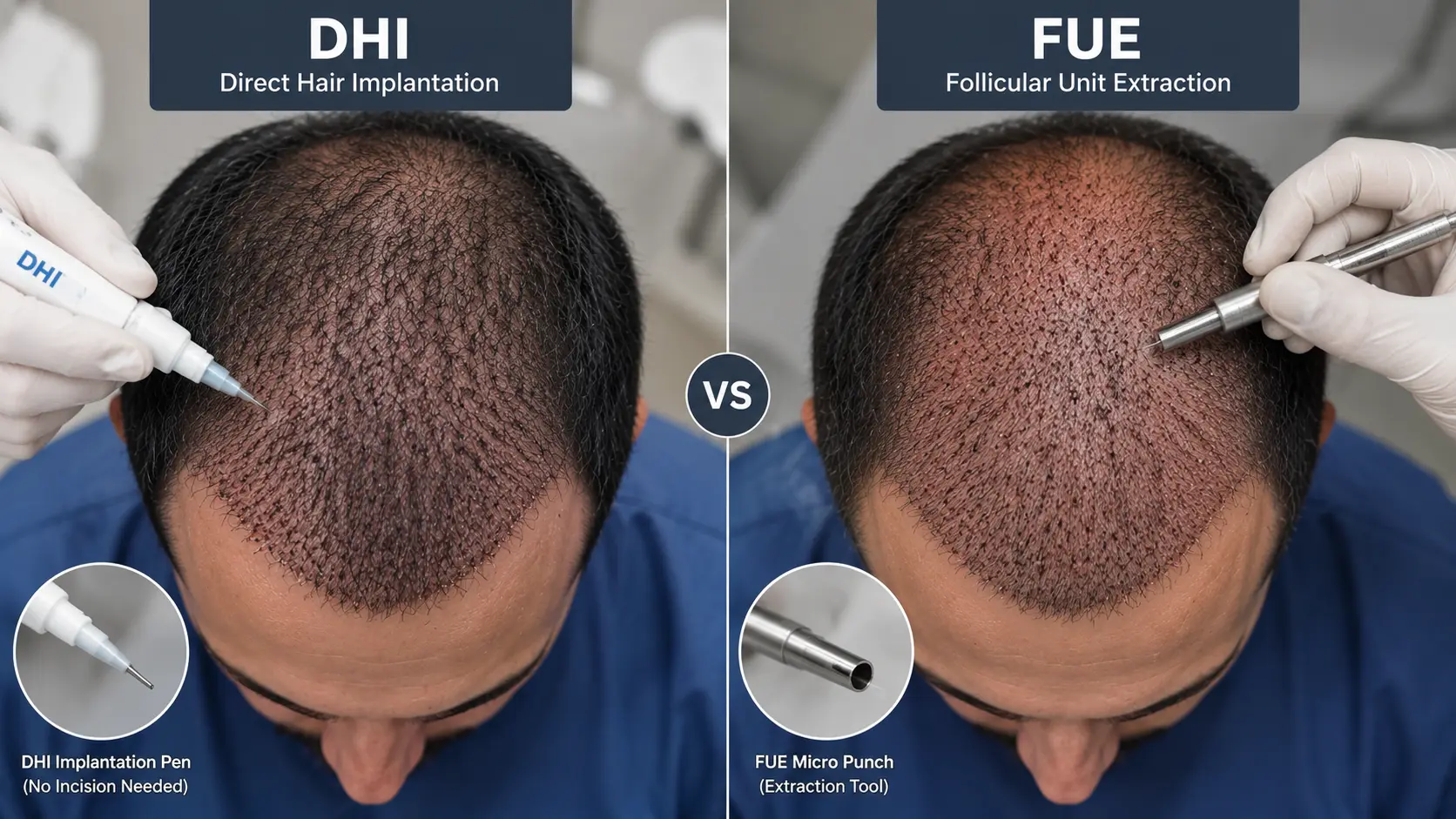
DHI vs FUE comes down to one key relationship that many people misunderstand. DHI is not a separate transplant method competing against FUE, it is a specific way of implanting grafts that are still extracted using FUE. The real choice is not between two unrelated surgeries, it is between two different implantation workflows built on the same extraction foundation.
Understanding DHI vs FUE at the Technique Level
Both techniques start the same way, individual hair follicles are removed one at a time from the donor area, usually the back and sides of the scalp. This extraction method was first introduced into the medical literature in 2002, described by Rassman and colleagues as a minimally invasive alternative to the older strip based approach still used in FUT hair transplants. Where DHI and FUE actually diverge is in how those extracted grafts get placed back into the scalp.
The Real DHI vs FUE Distinction
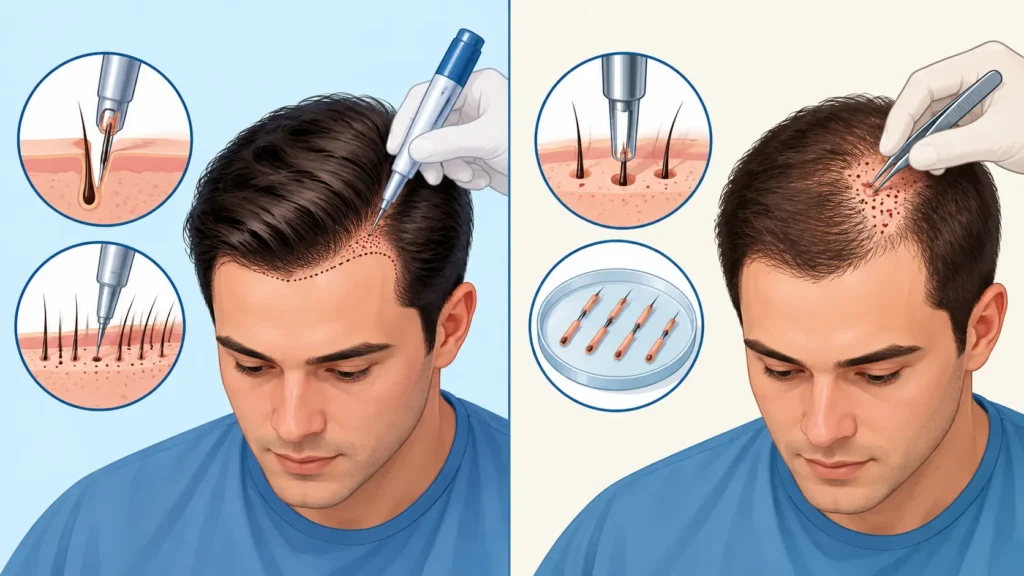
The most common misunderstanding in the DHI vs FUE conversation is treating them as two separate surgeries. They are not. DHI grafts are extracted using the exact same FUE method described above, the difference is entirely in what happens next, whether channels are opened first and filled with forceps, or created and filled in a single motion with a pen shaped tool.
What Is FUE Hair Transplant
In classic FUE, the surgeon first creates small recipient channels across the treatment area using a needle or blade, then places each graft into a pre made channel using forceps. Total procedure time and FUE cost and recovery both scale with how many grafts are needed, since more grafts mean more channels to open and fill. This two step process, channel creation followed by separate placement, gives the surgical team flexibility in planning density and coverage across large areas before any grafts are inserted.
What Is DHI Hair Transplant
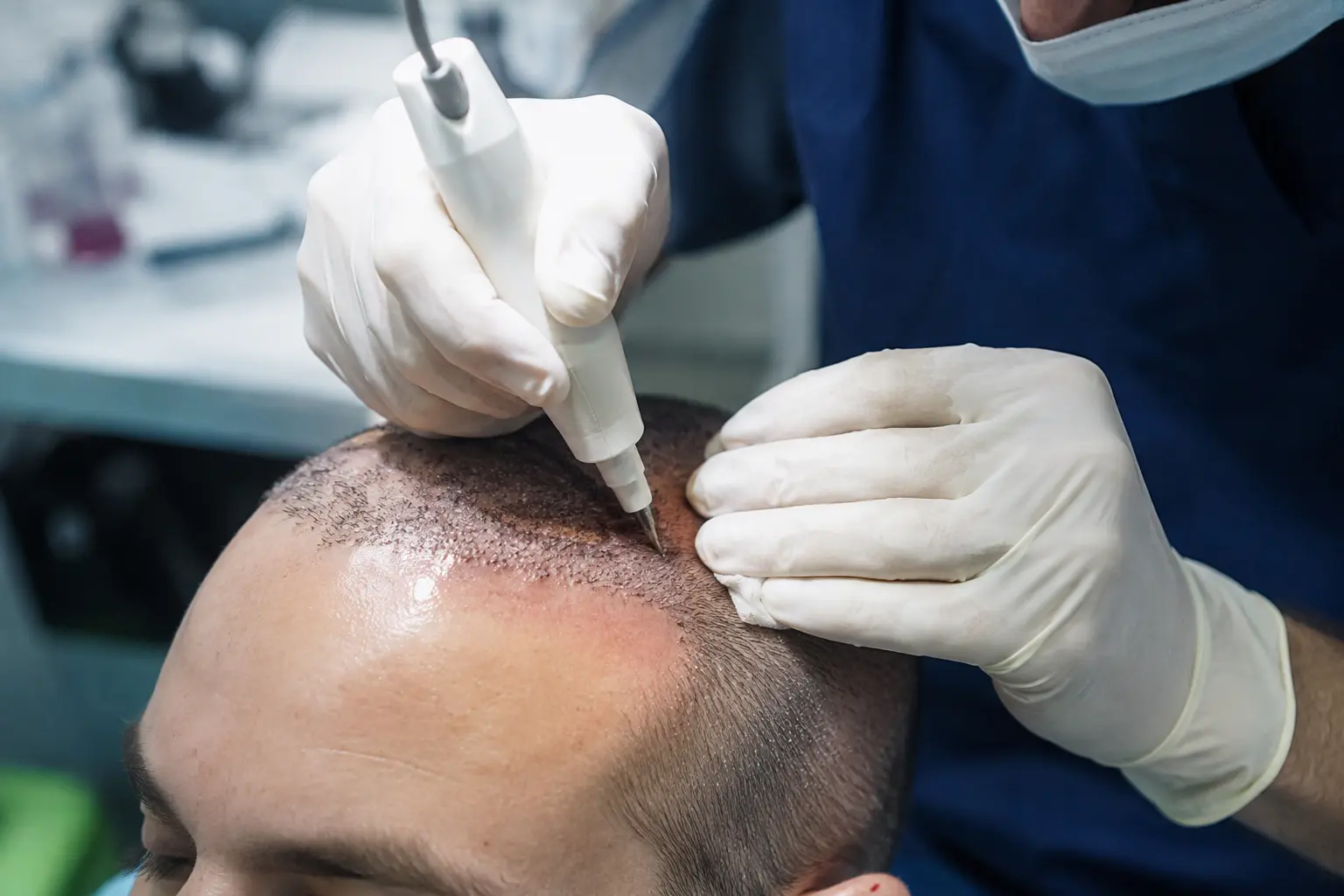
DHI stands for direct hair implantation. Instead of opening channels first, the surgeon loads each graft into a hollow, pen shaped tool, commonly called a Choi implanter pen, that creates the channel and inserts the follicle in a single motion. This combines two separate steps into one, which can shorten the time a graft spends outside the body.
DHI vs FUE Comparison Table
| Factor | FUE | DHI |
|---|---|---|
| Extraction method | Individual follicles removed one by one | Same individual extraction method as FUE |
| Channel creation | Separate step, done before implantation | Combined with implantation in one motion |
| Implantation tool | Forceps | Choi style implanter pen |
| Graft handling time | Longer, grafts wait before placement | Shorter, grafts implanted almost immediately |
| Precision over angle and depth | Good | Very high |
| Best suited for | Large treatment areas, higher graft counts | Hairline detail, smaller high precision zones |
| Typical procedure length | Shorter for the same graft count | Often longer due to added precision |
| Shaving requirement | Donor area, sometimes full scalp | Donor area, partial shave sometimes possible |
DHI vs FUE: Who Should Choose Which
The right choice depends more on your hair loss pattern and priorities than on which tool sounds more advanced.
FUE tends to fit patients with larger areas of hair loss who need a high total graft count in one session, since pre made channels allow a team to work efficiently across a wide area. DHI tends to fit patients focused on a smaller, cosmetically critical zone, most often the hairline or temples, where fine control over each follicle’s angle and direction has the most visible impact. Many experienced surgeons use both within the same session, standard FUE placement for broad coverage and DHI pens for the front hairline where detail matters most.
FUE Extraction Variants Worth Knowing
Not all FUE extraction is performed the same way, and this distinction matters more than most comparisons mention, since DHI grafts are harvested using one of these same three approaches. The extraction method chosen affects graft quality just as much for DHI as it does for standard FUE. However Sapphire FUE is a variation of the FUE technique that uses sapphire blades to create recipient channels. It can offer precise channel creation while maintaining the minimally invasive nature of FUE.
Manual FUE
In manual FUE, the surgeon scores and removes each follicle entirely by hand, without any powered assistance. This gives the surgeon direct tactile feedback throughout the extraction, which can help judge the angle and depth of each follicle more precisely, particularly in patients with tightly curled or unusually angled hair. The tradeoff is speed, manual extraction takes considerably longer per graft, which can limit how many follicles are realistically harvested in a single session.
Motorized FUE
Motorized FUE uses a powered handpiece to rotate or oscillate the punch, cutting extraction time significantly compared to manual technique. This makes it the more common choice for larger sessions requiring thousands of grafts. The tradeoff is that the added speed leaves less margin for error, an inconsistent depth or angle can raise the risk of damaging follicles during extraction, so outcomes depend heavily on the surgeon’s skill and experience with the specific device being used.
Hybrid FUE
Hybrid FUE combines both approaches within the same session, using motorized extraction across most of the donor area for efficiency, then switching to manual technique in smaller, more delicate zones where precision matters more than speed. This approach aims to capture the time savings of motorized extraction without giving up the control manual technique offers in the areas where it counts most.
What the Research Actually Shows on Graft Survival
This is where marketing claims tend to outpace the actual evidence. The foundational 2002 study that introduced FUE never directly compared it against pen based implantation, since DHI as a distinct workflow came later, and a separate 2006 study focused on reducing follicle transection reported an average rate of 6.14% using an improved extraction system, an issue tied to extraction technique, not implantation method. Randomized, head to head data comparing DHI implantation against forceps based FUE implantation remains limited in the published literature, so claims that one implantation method produces meaningfully higher survival rates should be treated as clinical opinion backed by surgeon experience, not settled research.
Recovery and Growth Timeline
Recovery follows a similar biological path regardless of which implantation method is used, since both rely on the same extraction process and the same healing scalp. Transplanted hairs typically shed within two to 6 weeks after the procedure, a normal phase called “shock loss”. New growth usually begins around 3 to 4 months, becomes clearly visible by month 6, and reaches full thickness and texture between months 12 and 18.
DHI vs FUE Cost
DHI generally costs more than FUE per graft. Reported pricing varies by clinic, with some estimates around $5 to $6 per graft, and others reporting $10 to $15 per graft, putting a full session between $18,000 and $28,000.
FUE typically runs $3 to $8 per graft in the United States, with a full procedure commonly totaling $7,000 to $15,000, sometimes exceeding $20,000 at premium clinics. FUE vs FUT costs are different from DHI vs FUE.
Summary
DHI vs FUE is not a contest between two competing surgeries, it is a choice between two implantation workflows that both rely on the same FUE extraction method. FUE uses pre made channels and forceps, making it efficient for large treatment areas, while DHI uses a pen that creates the channel and places the graft in one motion, offering finer control for detailed zones like the hairline. Graft survival research to date has focused mainly on extraction technique rather than implantation method, so claims of one being definitively superior should be weighed carefully. The right choice depends on the extent of hair loss, budget, and how much precision a specific area of the scalp actually requires.
Frequently Asked Questions
Is DHI better than FUE?
Neither technique is universally better. DHI offers finer control for small, detailed areas like the hairline, while FUE is generally more efficient for covering larger areas with a higher graft count. The better option depends on individual hair loss patterns and goals.
Does DHI cost more than FUE?
Yes, DHI typically costs more due to the additional time, specialized tools, and larger surgical team the technique requires.
Can DHI and FUE be combined in one procedure?
Yes, many surgeons use standard FUE for broad coverage and DHI for the hairline or temples within the same session, matching each technique to the area where it adds the most value.
References
- Rassman WR, Bernstein RM, McClellan R, Jones R, Worton E, Uyttendaele H. Follicular Unit Extraction: Minimally Invasive Surgery for Hair Transplantation. Dermatologic Surgery, 2002.
- Harris JA. New Methodology and Instrumentation for Follicular Unit Extraction: Lower Follicle Transection Rates and Expanded Patient Candidacy. Dermatologic Surgery, 2006.
Disclaimer: This article is based on peer reviewed medical literature and offers a technically accurate comparison of DHI and FUE hair transplant techniques for general informational purposes only. It is not a substitute for professional medical advice.